Emergency departments and urgent care centers operate in high-demand environments where speed, accuracy, and scalability are essential. Billing systems must support rapid claim processing, maintain compliance, and minimize administrative burden. Choosing the right medical billing software for emergency and urgent care is critical for improving efficiency and supporting long-term growth.
As patient volumes increase and reimbursement requirements become more complex, healthcare organizations must rely on systems that streamline workflows and reduce operational friction.
Key Takeaways
- Software plays a central role in billing efficiency and accuracy
- Integrated systems reduce manual processes and improve consistency
- Scalable platforms support growth across multiple facilities
- Strong billing infrastructure improves reimbursement timelines
Key Features of Effective Billing Software
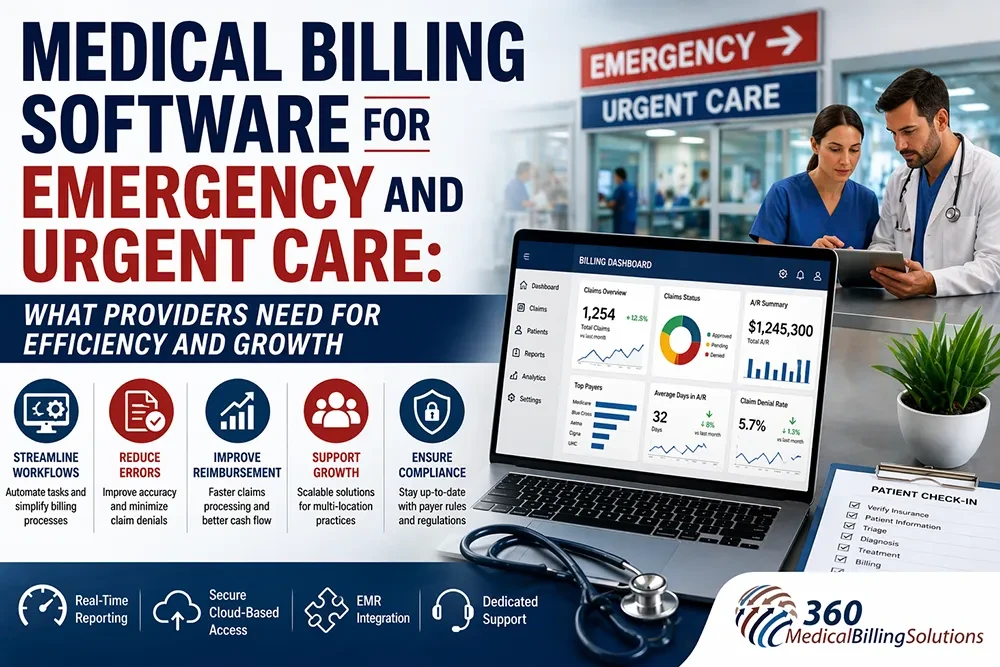
Billing software for emergency and urgent care environments must handle high claim volumes while maintaining accuracy. Essential features include:
- Automated claim scrubbing and validation
- Real-time eligibility and verification tools
- Integration with EMR and patient data systems
- Customizable reporting and analytics
Organizations that rely on comprehensive billing solutions designed for emergency departments and urgent care facilities managing high claim volumes are better positioned to maintain consistent billing performance and minimize errors.
Improving Efficiency Through System Integration
Integrated billing systems reduce redundancy and improve workflow efficiency by connecting multiple operational processes into a single system.
Facilities that implement integrated medical billing platforms that streamline data exchange and improve operational efficiency across healthcare systems benefit from:
- Reduced manual data entry
- Faster claim submission cycles
- Improved communication between systems
This level of integration is essential for maximizing the value of medical billing software for emergency and urgent care in complex healthcare environments.
Supporting Growth Across Multiple Locations
As emergency departments and urgent care providers expand, billing systems must be able to scale with operations.
Using scalable billing workflows that support multi-location emergency and urgent care operations without compromising accuracy allows organizations to maintain consistency while managing increased claim volumes.
This scalability ensures that the system can support both current needs and future growth.
Reducing Denials and Improving Financial Performance
Billing software directly impacts financial outcomes by reducing errors and improving claim accuracy.
Implementing advanced strategies for identifying and resolving billing inefficiencies that lead to claim denials in emergency and urgent care settings helps organizations improve reimbursement timelines and reduce administrative rework.
These improvements reinforce the importance of selecting the right medical billing software for emergency and urgent care to support both efficiency and revenue growth.
The Role of Technology in Long-Term Performance
Technology-driven billing systems provide visibility into performance metrics, enabling organizations to identify areas for improvement.
Adopting technology-enabled billing workflows that improve visibility into claims performance and operational efficiency across healthcare billing systems supports better decision-making and long-term operational success.
Over time, leveraging medical billing software for emergency and urgent care helps organizations build more resilient and efficient billing operations.
Case Example
A multi-location urgent care provider struggled with inconsistent billing processes and delayed reimbursements. By implementing a more integrated billing system and standardizing workflows, the organization was able to improve efficiency across all locations.
Within several months, the provider achieved:
- Faster claim processing times
- Improved billing accuracy
- Reduced administrative workload
This example highlights how the right technology can address operational challenges and support scalable growth.
Frequently Asked Questions (FAQs)
What is medical billing software used for in emergency and urgent care settings?
It is used to manage claims processing, reduce errors, and streamline billing workflows.
Why is software important for billing efficiency?
It automates processes, reduces manual tasks, and improves consistency.
Can billing software reduce claim denials?
Yes, by identifying errors before claims are submitted.
What features should providers look for in billing software?
Automation, integration, reporting tools, and scalability.
How does integration improve billing performance?
It connects systems, reducing redundancy and improving workflow efficiency.
Can billing software support multiple locations?
Yes, scalable platforms are designed to manage high volumes across facilities.
Does billing software improve reimbursement timelines?
Yes, by reducing errors and accelerating claim processing.
How does software help with compliance?
It ensures claims meet payer requirements through automated validation.
What causes inefficiencies in billing systems?
Manual processes, disconnected systems, and inconsistent workflows.
How can providers improve billing operations?
By implementing integrated systems and standardizing workflows.
How 360 Medical Billing Solutions Supports Efficient and Scalable Emergency and Urgent Care Billing
The experienced emergency and urgent care billing specialists at 360 Medical Billing Solutions have been supporting healthcare providers for over 25 years. The company focuses exclusively on emergency departments and urgent care environments, delivering structured billing solutions tailored to these settings.
Their approach is designed to improve financial performance, reduce operational inefficiencies, and streamline billing workflows, often with little or no initial upfront costs.
Take the Next Step
Evaluating billing systems and workflows can help identify opportunities to improve efficiency, reduce errors, and support long-term growth.
Request a consultation to review current billing operations and explore opportunities for improved performance.