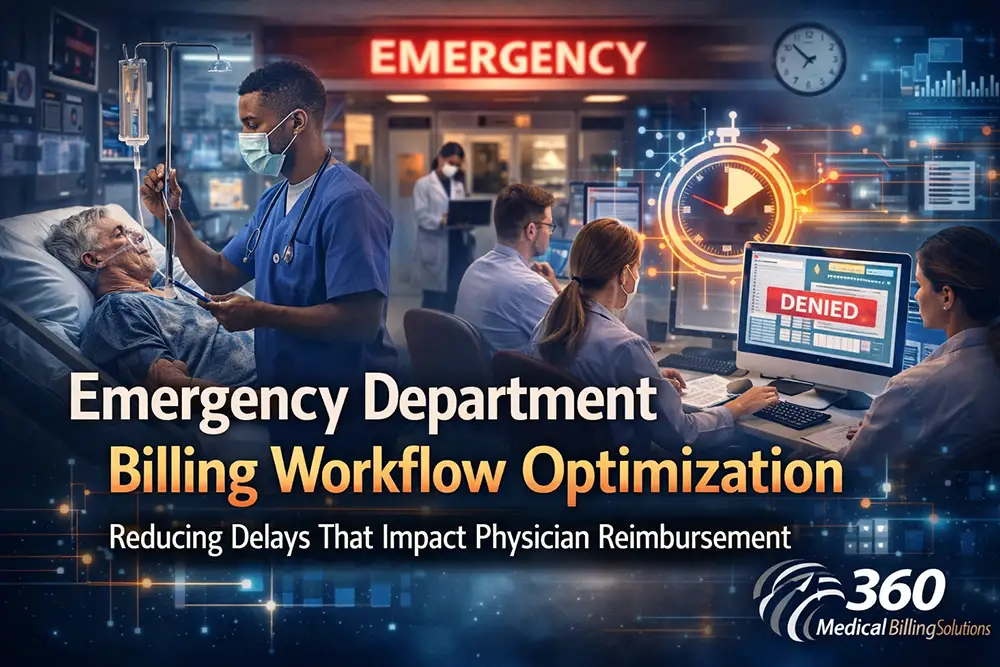
Emergency departments operate under constant pressure to deliver immediate care while managing complex billing requirements behind the scenes. High patient volume, unpredictable case severity, and varying payer requirements create a challenging environment for maintaining consistent reimbursement. Without structured emergency department billing workflow optimization, delays in claim processing, documentation, and follow-up can significantly impact physician revenue.
Even small inefficiencies in workflow—such as delayed charge entry or incomplete documentation—can cascade into longer reimbursement cycles and increased accounts receivable. For emergency physician groups, optimizing billing workflows is essential to maintaining financial stability and improving overall revenue cycle performance.
Key Takeaways
- Workflow inefficiencies are a leading cause of delayed emergency department reimbursement
- Charge lag and documentation delays directly impact physician revenue
- Structured billing workflows improve claim submission timing and accuracy
- Daily reporting provides visibility into operational bottlenecks
- Emergency department billing workflow optimization supports faster and more predictable reimbursement
Challenge #1: Charge Lag Delays
Charge lag refers to the time between patient discharge and when charges are entered into the billing system. In emergency departments, this delay can quickly disrupt the revenue cycle.
Common causes include:
- Delayed provider documentation
- Manual charge entry processes
- Missing encounter details
- Incomplete patient records
- Workflow inefficiencies between clinical and billing teams
Reducing charge lag is a critical component of improving reimbursement timelines.
Challenge #2: Documentation Gaps
Accurate and complete documentation is essential for proper coding and claim submission. In emergency settings, time constraints often lead to incomplete or inconsistent documentation.
Common documentation issues include:
- Missing medical necessity details
- Incomplete procedure descriptions
- Inconsistent E/M level documentation
- Lack of supporting clinical notes
- Delayed provider sign-offs
Improving documentation consistency reduces claim errors and supports faster reimbursement.
Challenge #3: Coding and Billing Workflow Disconnects
When coding and billing teams are not aligned with provider documentation, errors and delays occur. These disconnects often lead to rework and claim resubmissions.
Common issues include:
- Coding discrepancies
- Misinterpretation of documentation
- Delayed coding review
- Lack of communication between teams
- Inconsistent coding standards
Implementing emergency department billing workflow optimization helps align coding processes with documentation requirements.
Challenge #4: Claim Submission Delays
Delays in claim submission extend the revenue cycle and increase accounts receivable. Emergency departments must prioritize fast and accurate claim submission.
Contributing factors include:
- Incomplete patient registration
- Missing insurance verification
- Delayed coding completion
- Clearinghouse rejection issues
- Manual billing workflows
Submitting claims within 24–48 hours significantly improves reimbursement timelines.
Challenge #5: Inefficient Denial Follow-Up
Denials are inevitable, but delayed follow-up can create major revenue disruptions. Without structured workflows, denied claims may sit unresolved.
Key issues include:
- Lack of prioritization for denied claims
- Delayed resubmission timelines
- Inconsistent appeal processes
- Limited tracking of denial outcomes
- Poor visibility into denial trends
Proactive denial management improves cash flow and reduces accounts receivable aging.
Challenge #6: Limited Visibility Into Billing Performance
Without clear reporting, emergency physician groups cannot identify where delays are occurring. Visibility into billing performance is essential for workflow improvement.
Important reporting metrics include:
- Charge lag reports updated daily
- Claim submission timing
- Denial trends by category
- Payment timelines by payer
- Accounts receivable aging
These insights support continuous workflow improvement.
Case Example: Emergency Physician Group Reduces Workflow Delays
An emergency physician group experienced delayed reimbursement and rising accounts receivable days. Leadership identified inefficiencies in charge entry and claim submission workflows.
After implementing workflow improvements and daily performance reporting, the group:
- Reduced charge lag significantly
- Improved documentation turnaround time
- Accelerated claim submission
- Reduced denial volume
- Improved reimbursement predictability
These changes resulted in improved financial performance and reduced operational stress.
Best Practices for Emergency Billing Workflow Optimization
Emergency and urgent care organizations benefit most when denial tracking becomes part of a consistent workflow rather than a reactive task.
Emergency departments can improve reimbursement performance by standardizing workflows.
Recommended strategies:
- Complete documentation within 24 hours
- Submit claims within 24–48 hours
- Monitor denial trends daily
- Improve communication between providers and billing teams
- Standardize coding processes
- Use daily reporting to identify delays
These practices support efficient revenue cycle management.
Frequently Asked Questions (FAQs)
What is charge lag in emergency billing?
Charge lag is the delay between patient discharge and charge entry into the billing system.
Why does documentation impact reimbursement?
Incomplete documentation can lead to coding errors and claim denials.
How quickly should emergency claims be submitted?
Ideally within 24–48 hours after the patient encounter.
What causes claim submission delays?
Missing information, delayed coding, and workflow inefficiencies are common causes.
How can denial follow-up be improved?
By prioritizing denied claims and standardizing resubmission workflows.
What role does coding play in workflow optimization?
Accurate coding ensures claims are processed correctly and reduces rework.
Why is reporting important in emergency billing?
Reporting helps identify delays and operational bottlenecks.
How often should billing performance be reviewed?
Daily monitoring with monthly trend analysis is recommended.
Do workflow improvements reduce accounts receivable?
Yes, faster processing reduces claim aging.
Can workflow optimization improve physician revenue?
Yes, it leads to faster and more consistent reimbursement.
About 360 Medical Billing Solutions
360 Medical Billing Solutions has been providing emergency department billing services for 25 years. The company focuses on improving reimbursement accuracy, reducing denials, and optimizing billing workflows for physician groups.
Coding is handled by experienced emergency-focused coding partners who align documentation with payer requirements. This approach improves claim accuracy and reimbursement consistency. Organizations benefit from structured reporting, workflow optimization, and proactive denial management. There are little to no initial out-of-pocket costs, and services are designed to improve long-term financial performance.
Take the Next Step
If your emergency department is experiencing delayed reimbursement, rising accounts receivable, or workflow inefficiencies, optimizing your billing processes can significantly improve financial performance. Identifying delays and implementing structured workflows can create more predictable revenue cycles.
Request a consultation to learn how emergency department billing workflow optimization can improve reimbursement and strengthen your revenue cycle.