Urgent care centers operate in a high-volume, fast-paced environment where even small inefficiencies in billing workflows can create significant revenue leakage. From delayed charge capture to inconsistent follow-up on claims, these operational gaps directly impact financial performance. Improving urgent care cash flow through optimized billing workflows requires a structured, end-to-end approach that aligns front-end intake, coding accuracy, claims submission, and reimbursement tracking into a cohesive system.
Key Takeaways
- Streamlined Billing Workflows Accelerate Reimbursement Cycles
- Accurate Front-End Processes Reduce Denials
- Automation Improves Consistency And Efficiency
- Data Visibility Drives Ongoing Financial Performance Improvements
Where Cash Flow Breaks Down in Urgent Care Billing
Urgent care facilities often experience cash flow constraints not because of patient volume, but due to fragmented billing processes. Common breakdown points include:
- Incomplete Or Inaccurate Patient Intake Data
- Delayed Charge Entry And Coding Inconsistencies
- Lack Of Standardized Claims Submission Timelines
- Poor Visibility Into Denial Trends And Aging Accounts
These inefficiencies mirror challenges seen in emergency department billing workflows that reduce denials and accelerate reimbursement, where similar breakdowns directly impact revenue cycle performance.
Building a Workflow That Supports Faster Reimbursement
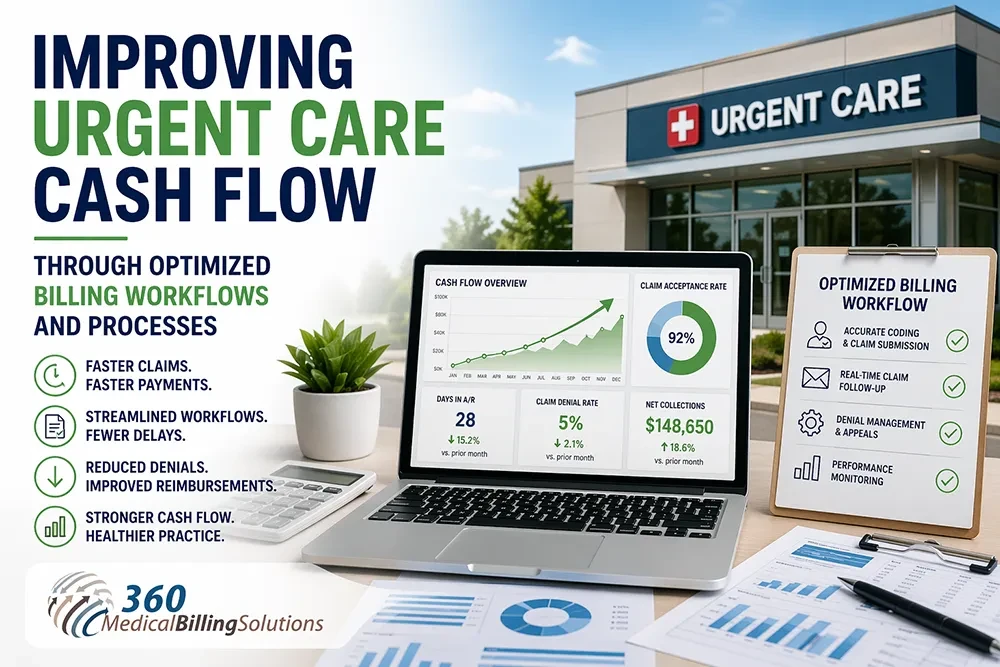
To achieve improving urgent care cash flow through optimized billing workflows, every stage of the revenue cycle must be aligned and optimized.
Front-End Optimization
Accurate patient data collection is the foundation. Verification of insurance eligibility, proper documentation, and standardized intake protocols reduce claim errors before they occur.
Charge Capture and Coding Alignment
Timely and accurate coding ensures claims are submitted correctly the first time. Implementing structured processes aligned with improving urgent care billing workflow efficiency for faster reimbursements and reduced delays helps eliminate inconsistencies across providers and shifts.
Claims Submission and Tracking
A disciplined submission schedule ensures consistency and accountability. When supported by urgent care medical billing services designed to improve cash flow and operational efficiency, urgent care centers gain the structure needed to prevent delays and maximize reimbursement.
Automation as a Cash Flow Multiplier
Manual processes introduce inconsistency and delay. Automation transforms billing workflows by standardizing repetitive tasks, reducing human error, and ensuring timely follow-ups.
Leveraging advanced medical billing software solutions that streamline urgent care revenue cycle management allows urgent care facilities to maintain control over claims processing while improving accuracy and speed.
Automation also enables:
- Faster Claims Submission Cycles
- Trigger-Based Follow-Up On Unpaid Claims
- Reduced Administrative Burden
- Increased Staff Productivity
When paired with strategies for reducing urgent care billing denials and improving revenue cycle performance, automation becomes a direct driver of improved cash flow.
The Role of Data Visibility in Financial Performance
Cash flow optimization requires continuous monitoring and adjustment. Key performance indicators (KPIs) include:
- Days In Accounts Receivable (AR)
- First-Pass Claim Acceptance Rates
- Denial Rates By Payer And Code
- Payment Turnaround Times
Without consistent reporting and analysis, inefficiencies go unnoticed and revenue opportunities are lost. This level of visibility is essential for improving urgent care cash flow through optimized billing workflows, allowing providers to identify inefficiencies and act on them quickly.
Case Example
A mid-sized urgent care group experiencing inconsistent monthly revenue identified multiple workflow inefficiencies, including delayed coding and lack of follow-up on denied claims.
After implementing structured billing workflows:
- Claims Submission Time Decreased By 30%
- Denial Rates Dropped Due To Improved Front-End Accuracy
- Accounts Receivable Cycles Shortened
The result was predictable cash flow, reduced administrative burden, and improved financial stability.
Frequently Asked Questions (FAQs)
What is the biggest factor affecting urgent care cash flow?
Inconsistent billing workflows and delayed claims processing are the most common causes.
How can urgent care centers reduce claim denials?
By improving front-end data accuracy and standardizing coding practices.
Why is automation important in billing workflows?
It reduces errors, improves efficiency, and ensures consistent follow-up.
How often should billing performance be reviewed?
Daily monitoring provides the best visibility into issues.
What role does billing software play in cash flow improvement?
It provides automation, tracking, and reporting capabilities.
Can workflow improvements increase revenue without more patients?
Yes, optimizing billing captures more revenue from existing volume.
What is the impact of delayed charge entry?
It delays claims submission and slows reimbursement.
How do clearinghouses improve billing efficiency?
They reduce errors before claims reach payers.
Is outsourcing billing a good option for urgent care centers?
Yes, especially when internal workflows are inconsistent.
How quickly can cash flow improve after workflow optimization?
Most improvements are seen within a few months.
Structured Billing Workflows That Drive Urgent Care Profitability
360 Medical Billing Solutions, medical billing specialists with a proven track record in urgent care and emergency department revenue optimization, brings over 25 years of experience specializing in emergency room and urgent care billing.
Their approach to improving urgent care cash flow through optimized billing workflows is designed to increase cash flow, reduce operational costs, and improve office efficiency—often with little or no initial upfront costs.
By implementing structured workflows, integrated systems, and disciplined reporting processes, they help urgent care providers maintain financial stability and long-term growth. Their services require the use of their billing platform to ensure full visibility across systems, including clearinghouse data and reporting tools.
Clients benefit from daily reporting (not real-time), improved claim accuracy, and a streamlined revenue cycle that supports consistent performance.
Take the Next Step
If your urgent care operation is experiencing inconsistent revenue or workflow inefficiencies, now is the time to take a strategic approach to your billing processes.