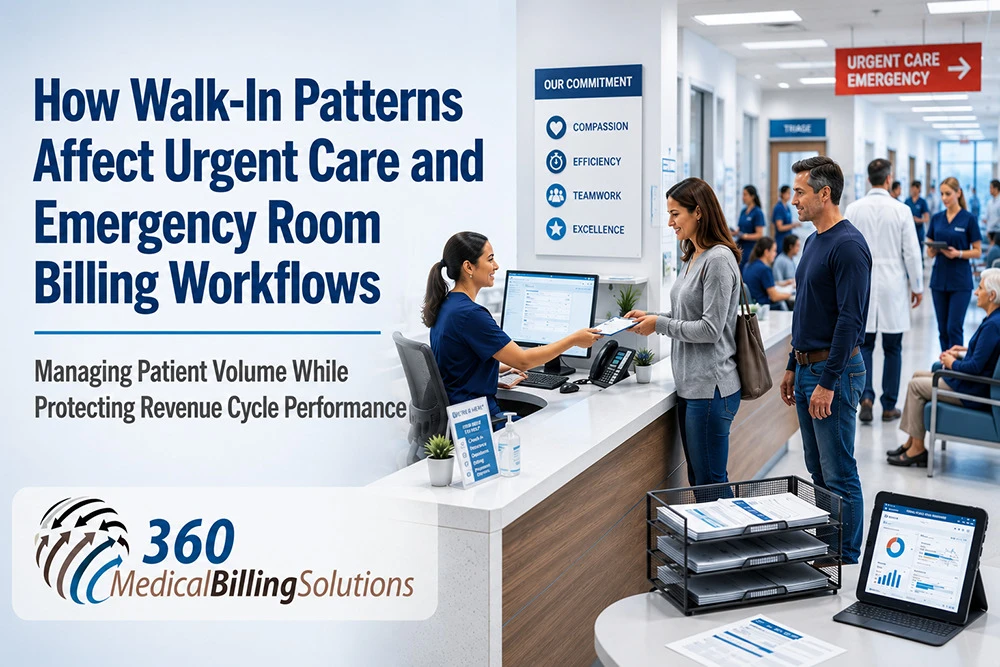
Walk-in patient volume is one of the most unpredictable factors affecting emergency departments, freestanding emergency rooms, emergency physician groups, and urgent care centers. Unlike scheduled medical practices, these facilities must be prepared to handle sudden surges caused by seasonal illnesses, severe weather, local events, accidents, or community health emergencies. While providers focus on delivering timely patient care, billing teams must simultaneously adapt to fluctuating workloads without sacrificing accuracy or reimbursement.
The efficiency of urgent care and emergency room billing workflows directly influences claim quality, reimbursement speed, and overall financial performance. When patient volumes increase unexpectedly, even minor disruptions in registration, documentation, coding, or claims submission can lead to payment delays, increased denials, and higher administrative costs. Organizations that understand these challenges and implement effective billing strategies are better positioned to maintain revenue stability regardless of patient volume.
Understanding Walk-In Patient Volume Trends
Unlike appointment-based medical practices, emergency and urgent care facilities rarely experience predictable patient schedules. Patient arrivals often fluctuate throughout the day, week, and year.
Common factors that influence walk-in volume include:
- Seasonal illnesses such as influenza, COVID-19, RSV, and other respiratory infections
- Severe weather events and natural disasters
- School schedules and community activities
- Tourist and seasonal population increases
- Workplace and motor vehicle accidents
- Sporting events and public gatherings
- Local disease outbreaks
These fluctuations place significant pressure on both clinical and administrative staff. Registration teams must process patients quickly while maintaining complete demographic and insurance information. Providers must document encounters accurately despite increased workloads. Billing departments then inherit the downstream effects of every decision made during the patient visit.
Even well-managed facilities can experience operational bottlenecks when patient demand exceeds available resources.
Why Walk-In Patterns Affect Revenue Cycle Performance
Revenue cycle performance depends on consistent, accurate information flowing through every stage of the billing process. Sudden increases in patient volume introduce additional opportunities for errors that can delay reimbursement.
Registration Accuracy
The registration process establishes the foundation for every medical claim. During busy periods, front-desk staff often work under significant time pressure while simultaneously assisting multiple patients.
Common registration challenges include:
- Incomplete demographic information
- Incorrect insurance policy numbers
- Missing subscriber information
- Outdated patient contact information
- Duplicate patient records
- Eligibility verification delays
Even small registration errors can trigger claim rejections before the payer evaluates medical necessity or coding accuracy.
Organizations that work with experienced emergency revenue cycle consultants often implement standardized registration procedures that improve data quality even during high-volume periods. These best practices help reduce preventable claim errors while supporting more consistent reimbursement through every stage of the revenue cycle.
Insurance Verification Challenges
Insurance verification becomes increasingly difficult when patient arrivals accelerate. Registration staff may have limited time to confirm eligibility, determine payer requirements, or identify authorization needs before treatment begins.
Emergency departments benefit from EMTALA protections that require evaluation and stabilization regardless of insurance status. However, accurate insurance information remains essential for timely reimbursement after services are provided.
Urgent care centers face different operational considerations. Many patients expect faster service than traditional physician offices, creating additional pressure to complete eligibility verification quickly without delaying patient care.
Efficient verification procedures reduce downstream billing delays while improving clean claim rates.
Documentation Timing
Clinical documentation frequently becomes more challenging during periods of heavy patient volume. Providers naturally prioritize patient care, often completing documentation after treating multiple patients.
Delayed documentation may result in:
- Missing clinical details
- Incomplete medical necessity support
- Delayed coding
- Questions from coding specialists
- Increased payer requests for additional documentation
These issues extend accounts receivable timelines while increasing administrative workloads.
How Walk-In Patterns Affect Urgent Care and Emergency Room Billing Workflows
As patient volume fluctuates throughout the day, every department contributes to overall billing efficiency. Registration, nursing documentation, physician documentation, coding, charge entry, quality review, and claims submission operate as interconnected processes rather than independent tasks.
When one step slows, the entire revenue cycle can be affected.
For example:
- Delayed provider documentation postpones coding.
- Coding delays postpone charge entry.
- Charge entry delays postpone claim submission.
- Late submissions delay reimbursement.
- Payment delays increase accounts receivable balances.
Organizations using integrated billing workflow technology can better coordinate these activities through automated work queues, electronic documentation, coding assistance, claim edits, and reporting dashboards. These technologies improve visibility across the revenue cycle and help billing teams prioritize high-value activities during peak patient volume periods.
Technology alone, however, cannot replace experienced personnel and well-designed operational processes. Successful organizations combine automation with specialized billing expertise to maintain consistency regardless of daily patient fluctuations.
Common Billing Challenges During Volume Surges
Walk-in surges often expose weaknesses that remain hidden during normal operating conditions. Administrative teams may struggle to keep pace with documentation reviews, coding validation, denial management, and payer follow-up.
Common issues include:
- Increased coding backlogs
- Delayed charge capture
- Higher claim rejection rates
- Missed filing deadlines
- Incomplete documentation supporting medical necessity
- Increased payer requests for records
- Longer reimbursement cycles
These challenges rarely result from a single problem. Instead, they reflect multiple small inefficiencies accumulating throughout the patient encounter.
Emergency physician groups frequently benefit from partnering with emergency physician billing specialists designed for high-volume emergency care —professionals who understand the unique documentation, coding, compliance, and reimbursement requirements associated with emergency medicine. Likewise, urgent care facilities often improve operational efficiency by utilizing urgent care billing support services designed specifically for episodic patient care.
Technology That Improves Billing Efficiency
Modern healthcare organizations increasingly rely on technology to maintain consistent billing performance despite unpredictable patient volumes. Automation reduces repetitive administrative work while helping staff identify potential claim issues before submission.
Technology can improve billing performance by supporting:
- Automated insurance eligibility verification
- Electronic charge capture
- Coding assistance tools
- Claim edit validation
- Work queue management
- Denial tracking and reporting
- Performance dashboards
- Electronic document management
These capabilities allow billing teams to process claims more efficiently while maintaining the quality standards necessary for successful reimbursement. When combined with experienced personnel and standardized procedures, technology helps organizations respond more effectively to changing patient demand without compromising revenue cycle performance.
Together, these capabilities help organizations build more resilient urgent care and emergency room billing workflows, allowing billing teams to adapt more effectively to changing patient volumes while maintaining billing accuracy and reimbursement performance.
How Specialized Medical Billing Partners Improve Workflow Stability
Managing fluctuating patient volume requires more than additional staff. Successful organizations establish standardized billing processes that remain effective whether patient visits are above or below average.
Specialized billing partners provide dedicated expertise that helps healthcare organizations maintain consistency throughout every stage of the revenue cycle. Their teams continually monitor payer requirements, regulatory updates, documentation standards, and reimbursement trends while identifying opportunities to improve operational performance.
Facilities that partner with trusted emergency and urgent care billing experts often experience improvements in clean claim rates, denial reduction, reimbursement turnaround times, and overall revenue cycle efficiency. Consistent billing processes also allow physicians and clinical staff to focus more attention on patient care while administrative teams manage the complexities of reimbursement.
Case Example
An urgent care center experienced significant increases in patient visits during respiratory illness season. Registration staff worked diligently to accommodate the higher patient volume, but increased workloads resulted in delayed documentation, coding backlogs, and longer claim submission timelines. As accounts receivable increased, management recognized the need to improve billing efficiency without disrupting patient care.
By implementing standardized workflow procedures, strengthening communication between clinical and billing teams, and using specialized revenue cycle support, the organization improved documentation turnaround, reduced claim processing delays, and stabilized reimbursement despite continued fluctuations in patient volume.
They also implemented proactive denial prevention strategies to identify potential claim issues earlier in the billing process, helping reduce preventable denials and improve reimbursement consistency.
This example illustrates how proactive workflow management and standardized urgent care and emergency room billing workflows can strengthen financial performance while supporting high-quality patient care.
Frequently Asked Questions
1. How do changing walk-in volumes affect billing operations?
Fluctuating patient volumes can increase administrative workloads, delay documentation, slow coding, and create reimbursement delays if billing processes are not designed to handle changing demand.
2. Why is registration accuracy so important during busy periods?
Accurate patient demographics and insurance information reduce claim rejections, minimize payment delays, and improve clean claim rates.
3. How can technology improve billing efficiency?
Technology supports eligibility verification, automated claim edits, coding assistance, reporting, and workflow management, allowing billing teams to process claims more efficiently.
4. Why do documentation delays affect reimbursement?
Incomplete or delayed documentation postpones coding and claim submission while increasing the likelihood of payer requests for additional information.
5. What are common causes of claim delays during patient surges?
Coding backlogs, registration errors, incomplete documentation, insurance verification issues, and delayed charge entry are among the most common contributors.
6. How can organizations reduce payer denials during high-volume periods?
Organizations can reduce denials by standardizing billing procedures, improving documentation quality, monitoring performance metrics, and identifying hidden causes of payer denials through ongoing revenue cycle analysis.
7. Should emergency and urgent care facilities outsource medical billing?
Many organizations benefit from specialized billing partners that understand emergency medicine documentation, coding requirements, compliance regulations, and payer expectations.
8. What metrics should administrators monitor to evaluate billing performance?
Important indicators include clean claim rates, denial rates, days in accounts receivable, reimbursement turnaround times, first-pass payment rates, and collection percentages.
9. How do specialized billing teams support revenue cycle performance?
Dedicated billing professionals continuously monitor payer changes, improve workflow efficiency, reduce administrative burdens, and help maximize reimbursement opportunities.
10. What qualities should healthcare organizations look for when selecting a billing partner?
Organizations should evaluate emergency and urgent care experience, regulatory knowledge, reporting capabilities, transparency, communication, compliance support, and long-term revenue cycle expertise.
How 360 Medical Billing Solutions Supports More Stable Billing Workflows
For more than 25 years, 360 Medical Billing Solutions has provided comprehensive medical billing services for Emergency Departments, Freestanding Emergency Rooms, Emergency Physician Groups, and Urgent Care Centers throughout the United States.
As trusted emergency and urgent care billing experts, our experienced team helps healthcare organizations improve reimbursement, reduce denials, strengthen compliance, optimize accounts receivable performance, and enhance overall revenue cycle management. We also provide comprehensive compliance audits, transparent reporting, and personalized client service tailored to the unique needs of emergency and urgent care providers.
Our services are often available with little to no initial out-of-pocket costs, making it easier for organizations to improve financial performance while maintaining exceptional patient care.
Take the Next Step
If fluctuating patient volumes are creating billing delays, increasing denials, or slowing reimbursement, it may be time to evaluate whether your current revenue cycle processes are keeping pace with your operational demands.
Contact us today to learn how our experienced team can help your organization maintain efficient billing workflows, even during periods of unpredictable patient volume.