
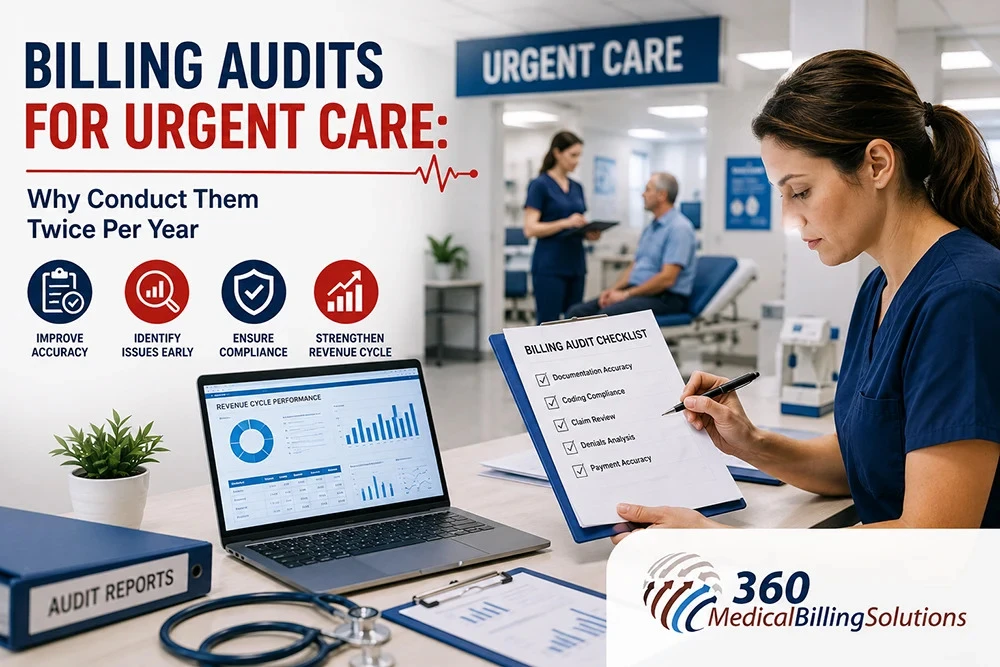
Urgent care centers operate in a fast-paced environment where high patient volumes, evolving payer requirements, and changing documentation standards can gradually affect billing performance. Even well-managed organizations may develop workflow inefficiencies or compliance issues over time. Conducting a billing audit for urgent care at least twice per year helps identify potential problems early, improve operational efficiency, and support a healthier revenue cycle.
Key Takeaways
- Semiannual Billing Audits Identify Revenue Cycle Issues Before They Grow
- Regular Reviews Improve Billing Accuracy And Workflow Efficiency
- Audit Findings Support Better Compliance And Operational Performance
- Ongoing Monitoring Helps Protect Long-Term Financial Stability
Why Semiannual Billing Audits Matter
Billing audits are not simply compliance exercises—they are valuable operational tools that help urgent care organizations evaluate billing performance, identify workflow gaps, and reduce preventable reimbursement problems.
Rather than waiting until denials or declining collections become noticeable, proactive audits help leadership identify trends before they significantly affect cash flow.
Organizations seeking to strengthen internal oversight can also learn about the role of compliance audits in emergency and urgent care billing and how regular reviews contribute to stronger revenue cycle performance.
Conducting a billing audit for urgent care every six months allows organizations to compare performance over time while ensuring operational improvements remain effective.
Audits Reveal Workflow Issues Before They Become Costly
Many billing problems develop gradually. Minor documentation inconsistencies, payer-specific billing variations, registration errors, or workflow inefficiencies may not immediately affect reimbursement but can accumulate over time.
Organizations utilizing urgent care revenue cycle workflows that promote billing consistency often use regular audits to evaluate:
- Claim Acceptance Rates
- Documentation Quality
- Registration Accuracy
- Payer Trends
- Accounts Receivable Performance
- Billing Workflow Efficiency
Reviewing these operational metrics helps leadership prioritize improvements before they become significant financial concerns.
Compliance Reviews Support Better Financial Performance
Healthcare regulations, payer policies, and documentation requirements continue to evolve. Semiannual billing audits help organizations verify that operational processes remain aligned with current industry expectations.
Organizations that coordinate emergency department billing operations alongside urgent care services often benefit from applying consistent audit standards across both environments. Working with experienced billing professionals, specialized emergency and urgent care coding partners, and internal leadership teams helps identify opportunities for process improvements while maintaining consistent revenue cycle performance.
Applying a billing audit for urgent care provides valuable operational insight that supports better financial decision-making, improved workflow consistency, and stronger long-term performance.
Technology Helps Make Audits More Effective
Modern reporting tools allow urgent care organizations to analyze billing performance using measurable operational data instead of assumptions. Trends involving denials, reimbursement timing, payer performance, and workflow efficiency become much easier to identify when accurate reporting is readily available.
Organizations utilizing billing performance reporting tools can review historical trends, compare audit results over time, and identify opportunities for continuous operational improvement.
Combining technology with regular operational reviews creates a more proactive approach to revenue cycle management and makes each billing audit for urgent care more valuable than relying solely on reactive problem-solving.
Case Example
A multi-location urgent care organization maintained steady patient volumes but noticed a gradual increase in claim denials and longer reimbursement cycles. Although individual issues appeared minor, leadership decided to conduct a comprehensive billing audit midway through the year.
Working with its billing partner and specialized urgent care coding vendor, the organization reviewed documentation quality, payer trends, registration accuracy, accounts receivable aging, and billing workflow performance. The audit identified several recurring issues, including inconsistent registration procedures, payer-specific claim edits, and workflow bottlenecks that delayed claim submission.
After implementing targeted process improvements, the organization experienced:
- Improved Billing Workflow Consistency
- Fewer Preventable Claim Edits
- Faster Claims Processing
- Better Visibility Into Revenue Cycle Performance
- More Efficient Operational Workflows
Although this example focuses on urgent care, many of the same audit principles also apply to emergency department billing operations, where proactive operational reviews help strengthen revenue cycle performance and workflow consistency.
Frequently Asked Questions About Billing Audits for Urgent Care
What is a urgent care billing audit?
A billing audit evaluates billing workflows, documentation, claims processing, and revenue cycle performance to identify opportunities for operational improvement and reduce preventable reimbursement issues.
Why should urgent care centers conduct billing audits twice per year?
Semiannual audits help identify workflow issues before they become significant financial problems while allowing organizations to measure improvement over time.
What areas are typically reviewed during a billing audit?
Audits commonly evaluate documentation, registration accuracy, payer trends, claim acceptance rates, accounts receivable, billing workflows, and operational processes.
Do billing audits improve compliance?
Yes. Regular reviews help organizations identify documentation inconsistencies, workflow deficiencies, and operational risks before they create compliance concerns.
Can billing audits reduce claim denials?
Billing audits often identify recurring issues that contribute to preventable claim edits and denials, allowing organizations to implement corrective actions.
Who should participate in a billing audit?
Leadership, billing professionals, operational staff, information technology personnel, and specialized coding partners all contribute valuable insight during the audit process.
Are billing audits only beneficial for large organizations?
No. Urgent care centers of all sizes benefit from regularly evaluating billing performance and operational efficiency.
How do reporting tools support billing audits?
Reporting software helps organizations monitor trends, compare historical performance, and identify recurring workflow issues using measurable operational data.
Should audit findings be tracked over time?
Yes. Comparing results from one audit to the next helps determine whether operational improvements are producing measurable benefits.
Can billing audits improve the patient experience?
Yes. More efficient billing processes reduce administrative delays, improve data accuracy, and contribute to smoother patient interactions.
How 360 Medical Billing Solutions Helps Improve Billing Audit Results
As medical billing specialists serving emergency departments and urgent care providers nationwide, 360 Medical Billing Solutions has over 25 years of experience helping healthcare organizations improve cash flow, reduce operational costs, and strengthen revenue cycle performance—often with little or no initial upfront costs.
Medical coding is performed by trusted third-party specialists with expertise in emergency medicine and urgent care. Working alongside these coding partners, 360 provides advanced reporting, workflow analysis, operational benchmarking, and revenue cycle management that help clients identify opportunities for continuous improvement following each urgent care billing audit.
Clients receive daily reporting (not real-time) that provides visibility into billing performance, reimbursement trends, operational efficiency, and revenue cycle metrics. To support ongoing audit reviews and workflow optimization, clients utilize the 360 Medical Billing Solutions billing software platform as part of their services.
Take the Next Step
If your urgent care organization wants to improve billing accuracy, strengthen operational efficiency, and identify opportunities for long-term revenue cycle improvement, now is the time to evaluate your current billing processes.