
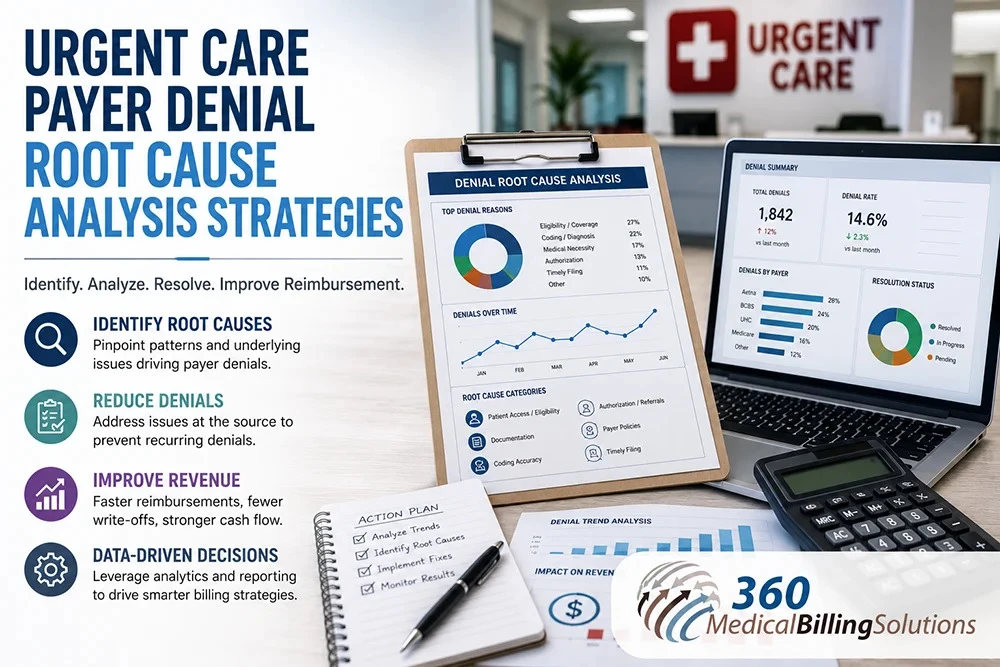
Urgent care facilities face growing reimbursement pressure due to evolving payer policies, rising claim complexity, and increasing administrative demands. When denial trends are not properly analyzed, recurring billing issues can quietly erode profitability and disrupt operational performance. Implementing urgent care payer denial root cause analysis strategies helps providers identify recurring reimbursement obstacles, reduce preventable denials, and improve long-term revenue cycle stability.
Key Takeaways
- Root Cause Analysis Helps Identify Recurring Denial Patterns
- Front-End Workflow Errors Frequently Trigger Denials
- Analytics Improve Visibility Into Payer-Specific Trends
- Workflow Standardization Supports Faster Reimbursement
Why Root Cause Analysis Matters in Urgent Care Billing
Many urgent care organizations focus on correcting denied claims individually rather than identifying the underlying operational patterns causing repeated reimbursement interruptions.
Without structured root cause analysis, organizations often experience:
- Recurring Eligibility Denials
- Coding-Related Claim Interruptions
- Delayed Reimbursement Cycles
- Increased Administrative Workload
- Higher Accounts Receivable Balances
- Inefficient Appeals Management
Organizations implementing urgent care denial management workflows that improve reimbursement consistency and reduce recurring claim issues often gain stronger visibility into operational inefficiencies affecting financial performance.
Front-End Registration and Verification Errors Often Trigger Denials
A large percentage of payer denials originate during patient intake and eligibility verification. Inaccurate demographic information, incomplete insurance details, and coordination-of-benefits errors frequently create preventable claim disruptions.
Facilities utilizing urgent care medical billing services that improve payer claims accuracy and reimbursement performance often strengthen denial prevention by improving front-end workflow consistency.
Important denial prevention safeguards include:
- Real-Time Eligibility Verification
- Accurate Insurance Validation
- Standardized Intake Procedures
- Coordination Of Benefits Review
- Documentation Accuracy Checks
As urgent care claim volume increases, workflow consistency becomes increasingly important to denial prevention efforts.
Payer Analytics Help Identify Recurring Denial Trends
Tracking denial trends over time helps organizations identify payer-specific reimbursement issues and operational weaknesses that may otherwise go unnoticed.
Facilities implementing healthcare clearinghouse analytics and denial reporting systems that improve urgent care reimbursement workflows gain stronger visibility into recurring denial causes and payer behavior patterns.
Important denial analysis metrics include:
- Denials By Payer
- CPT And ICD-10 Rejection Trends
- Medical Necessity Denials
- Timely Filing Issues
- Authorization-Related Rejections
Tracking recurring urgent care payer denial root cause analysis strategies allows organizations to proactively improve reimbursement workflows before denial trends escalate into larger operational problems.
Organizations focused on reducing urgent care reimbursement interruptions through denial analysis and workflow optimization strategies frequently improve both reimbursement consistency and operational efficiency.
Workflow Automation Improves Denial Prevention and Follow-Up
Manual denial management processes often create delayed follow-up, inconsistent documentation, and missed reimbursement opportunities. Workflow automation helps standardize processes while improving denial visibility and operational accountability.
Urgent care organizations utilizing medical billing software systems designed to improve denial tracking and urgent care workflow efficiency often strengthen reimbursement performance while reducing administrative burden.
Automation benefits include:
- Automated Denial Tracking
- Faster Claims Review Processes
- Standardized Appeals Workflows
- Workflow Task Routing
- Improved Follow-Up Visibility
Automation also helps organizations refine urgent care payer denial root cause analysis strategies by improving reporting consistency and operational oversight.
Organizations implementing improving urgent care reimbursement performance through automated denial management workflows frequently reduce preventable revenue loss while improving reimbursement timelines.
Case Example
A multi-location urgent care group experienced rising denial rates tied to recurring eligibility verification errors and inconsistent documentation practices. Administrative staff were spending significant time correcting repeat payer issues without identifying the underlying workflow causes.
After implementing centralized denial analytics, standardized intake workflows, and automated denial tracking systems:
- Repeat Denial Rates Declined
- Eligibility Verification Accuracy Improved
- Appeals Processing Became More Efficient
- Reimbursement Cycles Became More Predictable
The organization reduced operational inefficiencies while improving overall revenue cycle performance.
Frequently Asked Questions (FAQs)
What is denial root cause analysis in urgent care billing?
It is the process of identifying recurring operational issues that contribute to payer denials.
Why are payer denials common in urgent care billing?
High patient volume, eligibility issues, documentation inconsistencies, and payer-specific rules often contribute to denials.
How can urgent care centers reduce denials?
Improving intake accuracy, workflow standardization, analytics, and automation can significantly reduce denials.
What role does automation play in denial management?
Automation improves workflow consistency and accelerates denial tracking and follow-up.
Why is eligibility verification important?
Incorrect or incomplete insurance information is one of the leading causes of preventable denials.
How do analytics improve denial prevention?
Analytics help organizations identify recurring denial trends and payer-specific issues.
What are common urgent care denial categories?
Eligibility issues, coding errors, medical necessity disputes, and timely filing denials are common categories.
How often should denial trends be reviewed?
Daily reporting and ongoing trend analysis provide the strongest operational visibility.
Can workflow optimization improve reimbursement timelines?
Yes. More efficient workflows typically reduce reimbursement delays and operational bottlenecks.
Why is standardized documentation important?
Consistent documentation improves claims accuracy and reduces preventable denials.
Structured Denial Analysis Helps Improve Urgent Care Reimbursement Performance
360 Medical Billing Solutions, medical billing specialists helping urgent care and emergency room providers improve denial prevention and reimbursement workflows, brings over 25 years of experience supporting providers with advanced denial management and revenue cycle optimization strategies.
Their approach to urgent care payer denial root cause analysis strategies is designed to improve cash flow, reduce operational costs, and strengthen reimbursement consistency—often with little or no initial upfront costs.
By combining denial analytics, workflow automation, reporting systems, and structured operational oversight, they help organizations improve visibility into recurring payer issues and reimbursement inefficiencies. Clients receive daily reporting and analytics (not real-time) that support proactive workflow improvement and denial prevention efforts.
To maintain reporting consistency and operational visibility, clients must utilize the 360 Medical Billing Solutions billing software platform as part of their services.
Take the Next Step
If your urgent care organization is struggling with recurring payer denials, reimbursement delays, or inefficient denial management workflows, now is the time to evaluate your operational processes.