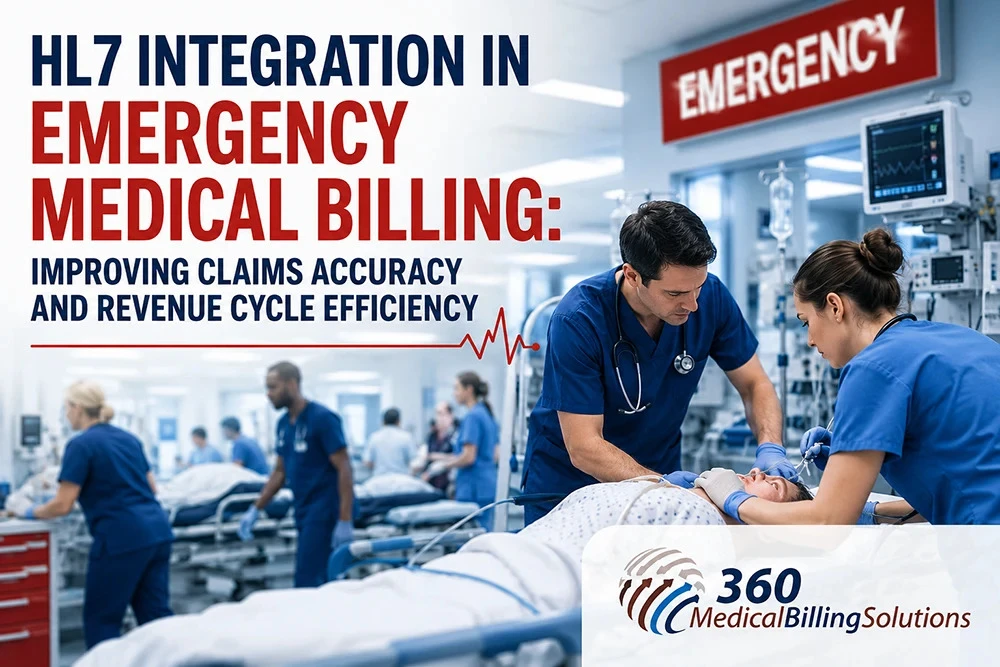
Emergency departments rely on the rapid exchange of accurate patient and billing information to maintain efficient revenue cycle operations. When clinical and billing systems fail to communicate effectively, claim delays, manual data entry, and preventable reimbursement issues often follow. Implementing HL7 integration in emergency medical billing helps healthcare organizations improve data accuracy, streamline claims processing, and strengthen overall revenue cycle efficiency.
Key Takeaways
- HL7 Integration Improves Communication Between Clinical and Billing Systems
- Automated Data Exchange Reduces Manual Entry Errors
- Better Data Quality Supports Faster Claims Processing
- Integrated Workflows Improve Revenue Cycle Efficiency
Why HL7 Integration Matters in Emergency Medical Billing
HL7 (Health Level Seven) is a widely adopted interoperability standard that enables healthcare systems to exchange patient, clinical, and financial information electronically. In emergency medicine, where speed and accuracy are essential, HL7 integration reduces delays by allowing information to move seamlessly between electronic medical records (EMRs), billing platforms, laboratory systems, radiology systems, and other healthcare applications.
Without effective system integration, organizations often experience:
- Duplicate Data Entry
- Incomplete Patient Information
- Delayed Charge Capture
- Increased Claims Exceptions
- Higher Administrative Workloads
- Slower Reimbursement Cycles
Organizations that invest in reliable system integration often experience fewer operational bottlenecks and improved claims accuracy throughout the revenue cycle.
Healthcare organizations interested in learning more about HL7 integration for emergency department billing workflows can explore how standardized data exchange improves interoperability, streamlines claims processing, and supports more efficient revenue cycle operations.
Accurate Data Exchange Improves Claims Quality
Every claim begins with accurate clinical and demographic information. When data is transferred electronically instead of being entered manually, the risk of transcription errors, missing information, and inconsistent patient records is significantly reduced.
Facilities utilizing well-designed emergency department billing workflows often benefit from cleaner claim data and more consistent billing operations when supported by effective HL7 interfaces.
Reliable data exchange helps organizations improve:
- Patient Demographic Accuracy
- Charge Capture
- Coding Documentation Availability
- Insurance Information Validation
- Claim Submission Readiness
The result is a more efficient billing process with fewer preventable claim interruptions.
Integrated Systems Reduce Manual Workflow Bottlenecks
Emergency departments frequently use multiple software platforms to manage patient registration, clinical documentation, laboratory services, imaging, and billing. Without integration, staff members often spend valuable time transferring information between systems.
Applying HL7 integration in emergency medical billing allows information to move automatically between connected applications, reducing administrative effort while improving operational efficiency.
Organizations utilizing EMR integration solutions that improve clinical and billing data exchange frequently experience:
- Faster Registration Processing
- Improved Documentation Availability
- Reduced Manual Data Entry
- More Consistent Patient Records
- Improved Billing Workflow Efficiency
Automation not only improves productivity but also reduces opportunities for human error throughout the revenue cycle.
Better Interfaces Support Stronger Revenue Cycle Performance
Successful HL7 integration extends beyond connecting systems. Organizations must also monitor interface performance, validate transmitted data, and quickly resolve communication errors before they affect billing operations.
Healthcare organizations using healthcare clearinghouse solutions for efficient claims management often complement HL7 integration by validating claim data before submission, reducing claim edits and improving first-pass acceptance rates.
Combined with ongoing monitoring and workflow optimization, HL7 integration in emergency medical billing provides a stronger operational foundation for improving claims accuracy and revenue cycle efficiency.
Case Example
A hospital-based emergency department experienced recurring claim delays despite maintaining strong registration and billing procedures. An internal review determined that patient demographic information and clinical documentation were not consistently transferring between the electronic medical record and billing system, creating manual workarounds and increasing claim exceptions.
Working with its information technology team, billing partner, and specialized emergency medicine coding vendor, the organization identified several HL7 interface mapping issues that affected charge capture and data consistency. After correcting the interface configuration and implementing ongoing monitoring procedures, the emergency department achieved:
- Improved Data Accuracy Between Systems
- Fewer Claims Requiring Manual Correction
- Faster First-Pass Claim Acceptance
- Reduced Administrative Workload
- More Consistent Revenue Cycle Performance
While this case focuses on an emergency department, many of the same integration strategies also benefit urgent care revenue cycle management by reducing administrative delays, improving claims accuracy, and supporting more efficient billing operations.
Frequently Asked Questions (FAQs)
What is HL7 integration in emergency medical billing?
HL7 integration allows healthcare systems to exchange patient, clinical, and billing information electronically, improving communication between software applications and reducing manual data entry.
Why is HL7 important for emergency departments?
Emergency departments depend on timely, accurate information. HL7 helps ensure patient and billing data moves efficiently between clinical and financial systems.
How does HL7 improve claims accuracy?
Automated data exchange reduces transcription errors, missing information, and inconsistent patient records before claims are submitted.
Does HL7 integration reduce manual billing work?
Yes. Integrated systems eliminate much of the manual data transfer that can slow billing workflows and introduce errors.
Which systems commonly use HL7 interfaces?
Electronic medical records, laboratory systems, radiology systems, registration software, billing platforms, and clearinghouses commonly exchange information using HL7 standards.
Can HL7 integration reduce claim denials?
While no system eliminates every denial, improved data accuracy helps reduce preventable claim edits and submission errors.
How does HL7 affect revenue cycle performance?
More accurate and timely information supports faster claims processing, improved reimbursement consistency, and greater operational efficiency.
Is HL7 only beneficial for hospitals?
No. Freestanding emergency departments and urgent care organizations also benefit from improved interoperability between clinical and billing systems.
Should HL7 interfaces be monitored after implementation?
Yes. Ongoing monitoring helps identify interface errors, data mapping issues, and communication failures before they affect claims processing.
Can HL7 integration improve patient experience?
Yes. More accurate information exchange reduces duplicate data collection, minimizes administrative delays, and supports more efficient patient care.
How 360 Medical Billing Solutions Maximizes the Value of HL7 Integration
As medical billing specialists serving emergency departments and urgent care providers nationwide, 360 Medical Billing Solutions has over 25 years of experience helping healthcare organizations improve cash flow, reduce operational costs, and strengthen revenue cycle performance—often with little or no initial upfront costs.
Working alongside healthcare providers, information technology teams, and specialized emergency and urgent care coding partners, 360 helps clients optimize billing workflows through interface reporting, operational analytics, revenue cycle management, and process improvement.
Clients receive daily reporting (not real-time) that provides visibility into reimbursement performance, claims activity, workflow efficiency, and revenue cycle metrics. To ensure consistent reporting and operational visibility, clients utilize the 360 Medical Billing Solutions billing software platform as part of their services.
Take the Next Step
If your emergency department is experiencing claim delays, workflow inefficiencies, or reimbursement challenges related to disconnected healthcare systems, now is the time to evaluate your integration strategy.