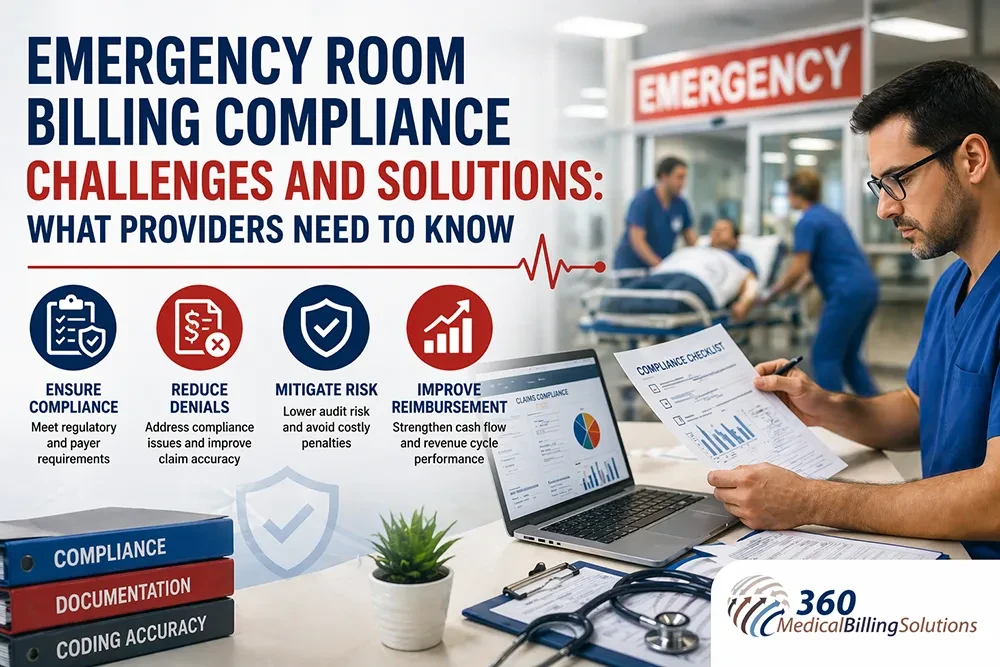
Emergency departments operate under strict regulatory requirements while managing high patient volumes and complex billing scenarios. Ensuring compliance with payer rules, documentation standards, and coding requirements is critical to avoiding penalties, delays, and lost revenue. Addressing emergency room billing compliance challenges and solutions requires a structured approach that aligns operational processes with regulatory expectations.
Understanding the most common compliance risks—and how to mitigate them—can help providers maintain accuracy, reduce denials, and protect reimbursement.
Key Takeaways
- Compliance issues often stem from documentation gaps and inconsistent workflows
- Regulatory requirements vary across payers and must be carefully managed
- Strong billing systems help reduce risk and improve accuracy
- Proactive compliance strategies improve reimbursement and operational efficiency
Common Emergency Room Billing Compliance Challenges
Emergency departments face a range of compliance challenges due to the nature of patient care and billing complexity. These challenges often include:
- Incomplete or inconsistent documentation
- Incorrect use of CPT and ICD codes
- Failure to meet payer-specific billing requirements
- Delays in claim submission
Addressing these issues requires a structured understanding of emergency room billing compliance challenges and solutions to ensure that claims meet all necessary guidelines before submission.
The Impact of Documentation Accuracy on Compliance
Accurate documentation is the foundation of compliant billing. Without proper clinical documentation, claims may be denied or flagged for audit.
Healthcare organizations that implement comprehensive billing support for emergency department providers managing complex compliance requirements are better positioned to ensure that all necessary information is captured and validated before claims are submitted.
Reducing Risk Through Workflow Standardization
Standardizing billing workflows helps reduce variability and improve compliance outcomes. Consistent processes ensure that claims are reviewed, validated, and submitted according to established guidelines.
Implementing advanced clearinghouse validation processes for high-volume emergency department claims allows organizations to identify errors before submission and maintain compliance with payer requirements.
Addressing Denials and Compliance-Related Errors
Compliance issues are a leading cause of claim denials. Identifying patterns in denied claims can help organizations uncover underlying compliance gaps.
Using in-depth methods for identifying compliance-related denial patterns in emergency room billing workflows enables providers to correct recurring issues and improve overall billing performance. Addressing these patterns is a key component of managing emergency room billing compliance challenges and solutions effectively.
Leveraging Technology to Improve Compliance
Technology plays a critical role in maintaining compliance across billing operations. Integrated systems allow for real-time validation, automated checks, and improved data accuracy.
Emergency departments often operate alongside urgent care facilities, making it important to align compliance strategies across both environments, particularly when working with efficient urgent care billing solutions for high-volume patient care environments to ensure consistency in claim processing and reimbursement.
When properly implemented, these systems support stronger adherence to regulatory requirements and help resolve emergency room billing compliance challenges and solutions more efficiently.
Case Example
An emergency department experienced recurring compliance-related denials due to inconsistent documentation and workflow gaps. By implementing standardized processes and improving claim validation, the organization was able to identify and correct compliance issues before submission.
Over time, the department achieved:
- Reduced compliance-related denials
- Improved documentation accuracy
- Faster reimbursement timelines
This demonstrates how a structured approach to emergency room billing compliance challenges and solutions can significantly improve financial and operational outcomes.
Frequently Asked Questions (FAQs)
What are the most common emergency room billing compliance issues?
Common issues include documentation errors, incorrect coding, and failure to meet payer requirements.
Why is compliance important in emergency room billing?
Compliance ensures accurate claims, reduces denials, and helps avoid penalties or audits.
How does documentation impact billing compliance?
Incomplete or inaccurate documentation can lead to denied claims or compliance violations.
What role do clearinghouses play in compliance?
They help validate claims and ensure they meet payer requirements before submission.
How can providers reduce compliance-related denials?
By standardizing workflows and identifying recurring denial patterns.
Can billing software improve compliance?
Yes, integrated systems help automate validation and reduce errors.
What causes compliance-related claim denials?
Errors in coding, missing documentation, and incorrect claim formatting.
How often should compliance processes be reviewed?
Regular reviews are recommended to ensure ongoing accuracy and adherence to regulations.
Are compliance audits common in emergency billing?
Yes, due to the complexity and high volume of claims.
What is the best way to manage compliance challenges?
By combining structured workflows, technology, and ongoing monitoring.
360 Medical Billing Solutions Expertise in Emergency Room Billing Compliance
The trusted emergency room billing experts at 360 Medical Billing Solutions have been supporting healthcare providers for over 25 years. The company focuses exclusively on emergency and urgent care environments, delivering structured billing solutions tailored to the demands of these settings.
Their approach is designed to improve revenue performance, reduce operational expenses, and enhance overall billing efficiency, often with little or no initial upfront costs.
Take the Next Step
Understanding compliance risks and implementing structured billing processes can help emergency departments reduce denials, improve accuracy, and strengthen reimbursement outcomes.
Request a consultation to evaluate current billing workflows and identify opportunities for improved compliance and performance.