
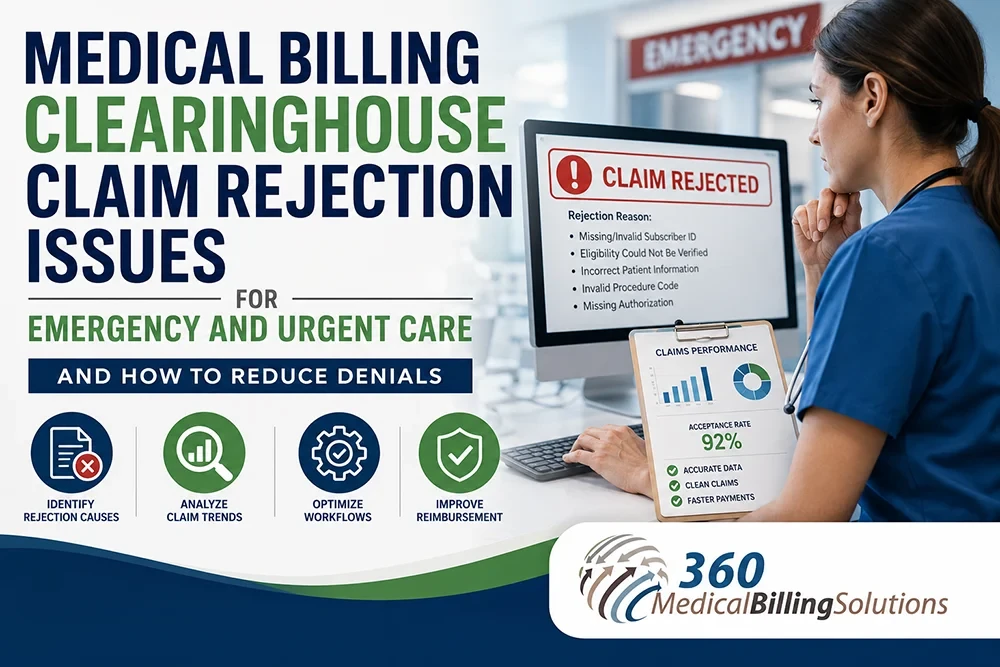
Emergency rooms and urgent care facilities depend on fast, accurate claims processing to maintain healthy cash flow and operational stability. However, clearinghouse claim rejections continue to create delays, increase administrative burdens, and disrupt reimbursement cycles. Understanding medical billing clearinghouse claim rejection issues is essential for providers seeking to reduce denials, improve claims acceptance rates, and strengthen revenue cycle performance.
Key Takeaways
- Clearinghouse Rejections Delay Reimbursement and Increase Administrative Costs
- Front-End Data Errors Are A Major Cause of Claim Rejections
- Workflow Standardization Improves First-Pass Acceptance Rates
- Ongoing Analytics Help Identify Recurring Rejection Patterns
Why Clearinghouse Rejections Continue to Impact Emergency and Urgent Care Providers
Clearinghouse claim rejections occur before claims ever reach the payer. These rejections are often tied to formatting issues, missing demographic information, invalid payer identifiers, coding inconsistencies, or eligibility mismatches.
For emergency departments and urgent care centers handling high claim volumes daily, even small data-entry errors can create major downstream revenue disruption.
Common rejection triggers include:
- Invalid Insurance Information
- Incorrect Patient Demographics
- Missing Provider Credentials
- CPT Or ICD-10 Coding Mismatches
- Incomplete Authorization Data
- Duplicate Claim Submissions
Organizations implementing emergency and urgent care billing workflow strategies that improve first-pass claim acceptance rates often experience significant reductions in avoidable rejections.
Front-End Intake Accuracy Plays a Critical Role
Many clearinghouse rejections originate long before the claim submission stage. Registration and intake workflows directly affect claim quality and reimbursement speed.
Facilities that rely on urgent care medical billing services that streamline claims processing and reimbursement performance often improve operational consistency by reducing front-end intake errors and improving insurance verification processes.
Important front-end safeguards include:
- Real-Time Eligibility Verification
- Standardized Intake Protocols
- Insurance Card Validation Procedures
- Accurate Patient Demographic Collection
- Verification of Referring Provider Information
Without disciplined intake procedures, rejection rates typically increase as claim volume grows.
Clearinghouse Analytics Help Identify Repeating Denial Patterns
One of the most effective ways to reduce clearinghouse rejection rates is through ongoing analytics and reporting. Repeated rejection codes often point to workflow weaknesses that can be corrected systematically.
Facilities using healthcare clearinghouse integration solutions that improve emergency and urgent care claims accuracy gain better visibility into recurring submission problems, payer-specific requirements, and operational inefficiencies.
Monitoring trends such as:
- Rejection Rates By Payer
- Error Frequency By Location
- Provider-Specific Submission Issues
- Coding-Related Rejections
- Timeliness Of Resubmissions
Tracking recurring medical billing clearinghouse claim rejection issues allows organizations to proactively improve claims performance instead of reacting after reimbursement delays occur.
Organizations focusing on reducing medical billing rejection errors through clearinghouse workflow optimization strategies often improve both operational efficiency and reimbursement predictability.
Workflow Automation Reduces Manual Submission Errors
Manual claims workflows increase the likelihood of inconsistent formatting, missing fields, and delayed corrections. Automation improves standardization and helps ensure claims meet payer and clearinghouse requirements before submission.
Facilities utilizing medical billing software systems designed to reduce claim submission errors and improve reimbursement workflows often achieve stronger claims consistency and improved staff productivity.
Automation benefits include:
- Automated Claim Scrubbing
- Eligibility Verification Workflows
- Standardized Submission Processes
- Faster Rejection Identification
- Accelerated Resubmission Timelines
In high-volume emergency and urgent care environments, automation can significantly reduce preventable claim interruptions. Automation also helps reduce medical billing clearinghouse claim rejection issues caused by inconsistent submission workflows and formatting errors.
Organizations implementing improving emergency room and urgent care reimbursement through denial prevention workflows frequently reduce administrative strain while improving reimbursement cycles.
Case Example
A regional urgent care and freestanding emergency group experienced growing reimbursement delays tied to recurring clearinghouse rejections. Analysis revealed that inconsistent intake procedures and payer-specific formatting issues were creating large numbers of rejected claims before payer adjudication.
After implementing standardized intake protocols, automated claim scrubbing, and centralized rejection tracking:
- First-Pass Claim Acceptance Rates Improved
- Rejection Volumes Decreased Substantially
- Staff Time Spent On Corrections Declined
- Reimbursement Cycles Became More Predictable
The organization improved operational efficiency while reducing unnecessary administrative workload.
Frequently Asked Questions (FAQs)
What is a clearinghouse claim rejection?
A clearinghouse rejection occurs when a claim fails validation before reaching the insurance payer.
How are claim rejections different from denials?
Rejections occur before payer processing, while denials occur after payer review.
What causes most clearinghouse rejections?
Common causes include demographic errors, coding issues, missing data, and invalid insurance information.
Why are emergency and urgent care facilities more vulnerable to rejections?
High patient volume and rapid intake processes increase the risk of submission inconsistencies.
How can providers reduce clearinghouse rejection rates?
Improving intake accuracy, workflow standardization, and automated claim validation can help reduce rejections.
What role does automation play in claims management?
Automation helps identify formatting and submission errors before claims are transmitted.
Can clearinghouse analytics improve reimbursement performance?
Yes. Analytics help identify recurring workflow issues and payer-specific rejection trends.
Why is first-pass claim acceptance important?
Higher first-pass acceptance rates accelerate reimbursement and reduce administrative costs.
How quickly should rejected claims be corrected and resubmitted?
Claims should be corrected and resubmitted as quickly as possible to minimize reimbursement delays.
Do clearinghouse issues affect cash flow?
Yes. Rejections delay claims processing and slow overall revenue cycle performance.
Structured Claims Management Improves Reimbursement Performance
360 Medical Billing Solutions, medical billing specialists with extensive experience supporting emergency room and urgent care reimbursement operations, brings over 25 years of experience helping providers reduce claim disruptions and strengthen revenue cycle performance.
Their approach to medical billing clearinghouse claim rejection issues for emergency and urgent care is designed to improve cash flow, reduce administrative costs, and streamline operational performance—often with little or no initial upfront costs.
By combining structured workflows, clearinghouse integration oversight, and advanced reporting systems, they help organizations improve claim accuracy and reduce avoidable reimbursement delays. Clients benefit from daily reporting and analytics (not real-time) that provide visibility into operational performance and recurring rejection trends.
To maintain consistency and reporting visibility, clients must utilize the 360 Medical Billing Solutions billing software platform as part of their services.
Take the Next Step
If your emergency room or urgent care organization is struggling with recurring clearinghouse rejections, delayed reimbursements, or inefficient claims workflows, now is the time to evaluate your revenue cycle processes.