Emergency departments face ongoing reimbursement challenges due to increasingly complex payer requirements, high patient volumes, and evolving documentation standards. Identifying recurring denial trends and implementing proactive prevention strategies in emergency rooms is critical for maintaining consistent cash flow and operational efficiency. Understanding emergency room billing denial patterns and prevention strategies helps providers reduce revenue disruption, improve claims accuracy, and strengthen overall revenue cycle performance.
Key Takeaways
- Recurring Denial Trends Often Reveal Workflow Weaknesses
- Front-End Accuracy Plays A Major Role In Denial Prevention
- Analytics Help Identify Payer-Specific Reimbursement Risks
- Standardized Billing Processes Improve Reimbursement Outcomes
Why Emergency Room Billing Denials Continue to Increase
Emergency departments manage a high volume of complex claims that often involve varying payer rules, coding requirements, medical necessity reviews, and eligibility challenges. Even small inconsistencies can trigger delayed reimbursement or claim denials.
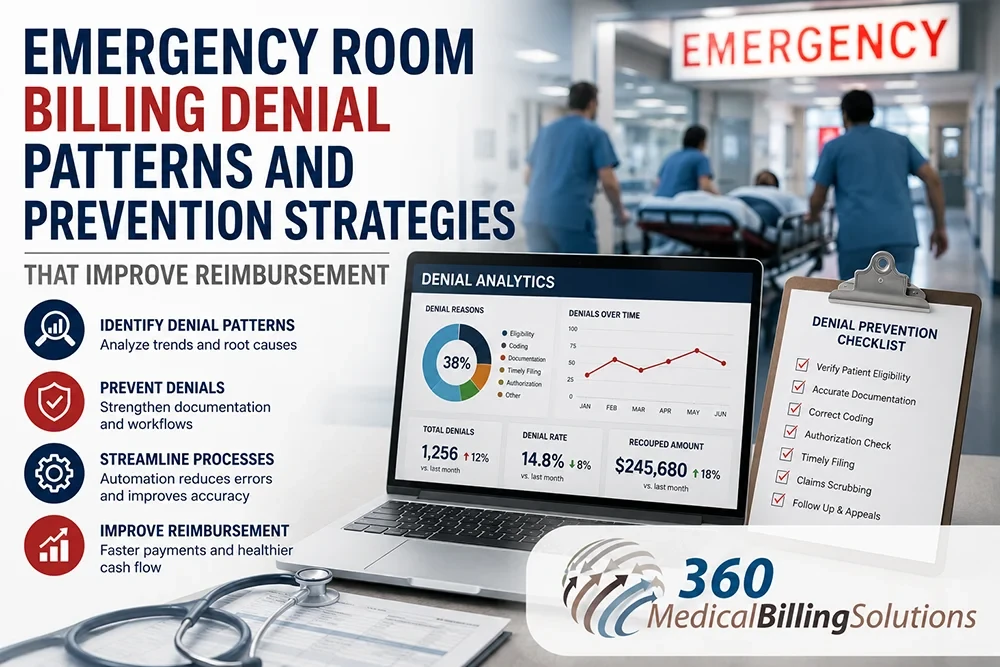
Common denial patterns include:
- Eligibility Verification Errors
- Incomplete Documentation
- Coding Inconsistencies
- Timely Filing Issues
- Authorization-Related Disputes
- Duplicate Claim Submissions
Organizations implementing emergency room claims workflow optimization strategies that reduce reimbursement delays and denial rates often improve claims consistency while reducing administrative strain.
Front-End Intake Processes Directly Affect Reimbursement
Many emergency room billing denials begin during patient intake and registration. Incorrect demographic information, outdated insurance details, and incomplete documentation frequently create preventable claim interruptions.
Emergency departments utilizing emergency physician billing services designed to improve reimbursement accuracy and denial prevention often improve first-pass acceptance rates by strengthening intake consistency and verification workflows.
Important intake safeguards include:
- Real-Time Eligibility Verification
- Accurate Insurance Validation
- Standardized Patient Registration Protocols
- Documentation Quality Checks
- Proper Coordination Of Benefits Review
As claim volume increases, standardized intake processes become even more critical to denial prevention efforts.
Analytics and Reporting Help Identify Recurring Denial Trends
Tracking denial trends over time provides valuable operational insight into payer behavior, workflow weaknesses, and recurring coding issues.
Facilities implementing healthcare clearinghouse reporting and denial management systems that improve emergency room claims performance gain greater visibility into recurring denial causes and reimbursement inefficiencies.
Important denial analytics include:
- Denials By Payer
- CPT And ICD-10 Rejection Patterns
- Timely Filing Denials
- Medical Necessity Trends
- Appeal Success Rates
Tracking recurring emergency room billing denial patterns and prevention strategies allows organizations to proactively improve claims performance instead of reacting after reimbursement delays occur.
Organizations focusing on reducing emergency room reimbursement interruptions through denial prevention workflow improvements often improve operational efficiency and revenue predictability.
Workflow Automation Improves Denial Prevention
Manual billing workflows increase the risk of inconsistent claim submission and delayed corrections. Automation improves standardization while helping staff identify potential claim issues before submission.
Emergency departments utilizing medical billing software platforms that improve emergency room revenue cycle efficiency and claims management often reduce preventable billing interruptions while improving staff productivity.
Automation benefits include:
- Automated Claim Scrubbing
- Real-Time Workflow Alerts
- Standardized Claims Submission Processes
- Faster Denial Identification
- Accelerated Appeals Management
Automation also helps reduce emergency room billing denial patterns and prevention strategies challenges caused by inconsistent documentation and workflow gaps.
Organizations implementing improving emergency department reimbursement through workflow automation and denial reduction strategies frequently strengthen reimbursement performance while reducing operational inefficiencies.
Case Example
A hospital-based emergency department experienced rising denial rates tied to documentation inconsistencies and payer-specific filing requirements. Denial volumes were increasing administrative workload while delaying reimbursement cycles.
After implementing standardized intake protocols, automated claim validation, and centralized denial tracking:
- First-Pass Acceptance Rates Improved
- Repeat Denial Patterns Declined
- Appeal Resolution Times Shortened
- Revenue Cycle Visibility Increased
The department reduced operational inefficiencies while improving reimbursement consistency across multiple payer groups.
Frequently Asked Questions (FAQs)
What are the most common emergency room billing denials?
Eligibility errors, coding inconsistencies, documentation gaps, and timely filing issues are among the most common denial causes.
Why do emergency room claims have high denial rates?
Emergency departments manage high claim volumes with complex payer requirements and rapid intake workflows.
How can emergency departments reduce billing denials?
Improving intake accuracy, workflow standardization, and denial analytics can significantly reduce denials.
What role does automation play in denial prevention?
Automation helps identify claim issues before submission and improves workflow consistency.
How do payer-specific rules impact reimbursement?
Different payer requirements can create recurring denial patterns if workflows are not standardized.
What is first-pass claim acceptance?
It refers to claims successfully processed without rejection or denial on initial submission.
Why are analytics important in denial management?
Analytics help organizations identify recurring denial trends and workflow weaknesses.
How do clearinghouses support denial reduction?
They help identify formatting and submission issues before claims reach payers.
Can denial prevention improve cash flow?
Yes. Fewer denials typically lead to faster reimbursement and more predictable revenue cycles.
How often should denial trends be reviewed?
Daily reporting and regular trend analysis provide the best operational visibility.
Denial Prevention Workflows Help Strengthen Emergency Room Reimbursement
360 Medical Billing Solutions, medical billing specialists supporting emergency room and urgent care revenue cycle optimization, brings over 25 years of experience helping providers reduce denial rates and improve reimbursement performance.
Their approach to emergency room billing denial patterns and prevention strategies is designed to improve cash flow, reduce operational costs, and strengthen billing efficiency—often with little or no initial upfront costs.
By combining structured workflows, denial analytics, and integrated billing systems, they help organizations improve operational visibility and reimbursement consistency. Clients receive daily reporting and analytics (not real-time) that support proactive denial prevention and workflow optimization.
To maintain reporting consistency and operational visibility, clients must utilize the 360 Medical Billing Solutions billing software platform as part of their services.
Take the Next Step
If your emergency department is struggling with recurring denials, delayed reimbursements, or inconsistent claims workflows, now is the time to evaluate your denial prevention strategies.