Introduction
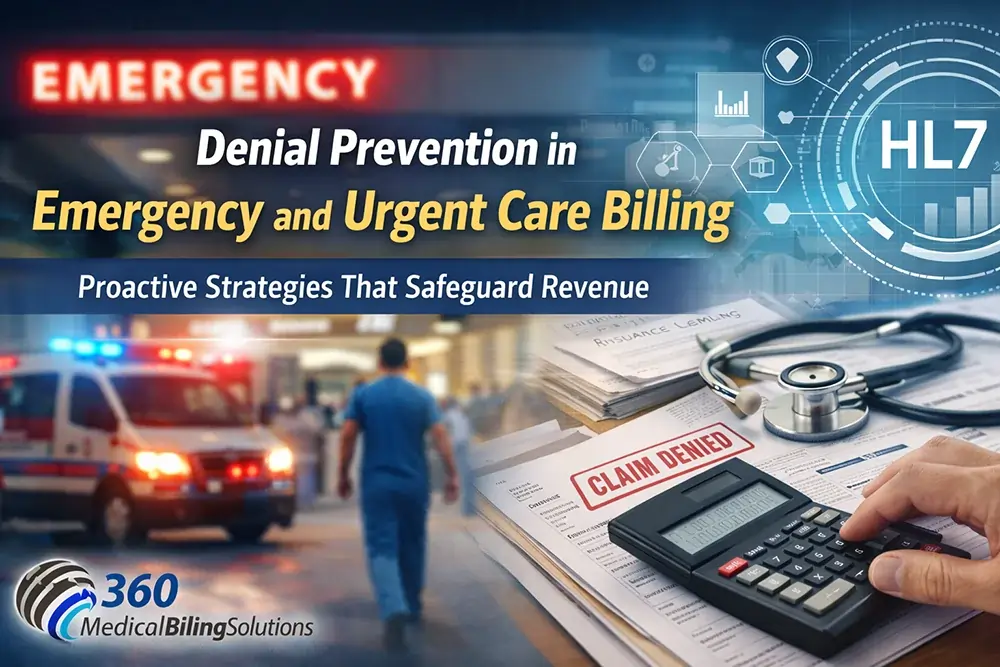
Denied claims aren’t just frustrating—they’re costly. For emergency departments and urgent care facilities, even a small uptick in denials can have major consequences on cash flow and operational stability. Many billing teams treat denials reactively, but that model is no longer sustainable. Facilities must embrace proactive denial prevention to stay profitable under tightening payer scrutiny.
Key Takeaways
- Learn why most billing denials can be prevented with early intervention.
- Understand how HL7 integration and real-time data audits reduce claim errors.
- See how third-party coding partners play a critical role in clean claims.
- Discover how 360 Medical Billing Solutions helps clients maintain denial rates well below national averages.
The True Cost of Denials
The American Medical Association (AMA) estimates that denial rates for medical claims range between 5% and 10% on average—but in high-volume emergency and urgent care settings, even 2% can represent hundreds of thousands in lost revenue. Denials delay payments, increase labor costs, and strain patient relationships when balances shift unexpectedly.
But here’s the most important point: the majority of denials are preventable.
According to a 2023 MGMA study, the top reasons for denial include:
- Missing or inaccurate patient information
- Incorrect coding
- Authorization issues
- Failure to meet medical necessity guidelines
Proactive Denial Prevention Starts with the Right Data
Clean claims begin with data integrity. That’s where HL7 interface engines come in. By using real-time data mapping from intake through coding and submission, billing teams can flag missing fields, mismatches, and authorization gaps before the claim is sent.
Facilities that integrate HL7 in healthcare workflows report 20–30% faster claims processing and far fewer downstream denials. At 360, HL7 integration ensures our clients receive seamless connectivity between their EHR, coding partners, and clearinghouse for full visibility into every data point that touches a claim.
Partnering with the Right Coding Experts
360 Medical Billing Solutions works closely with third-party coding partners who specialize in emergency, trauma, and urgent care environments. These coding professionals don’t just understand CPT and ICD-10—they know the intricacies of episodic billing, modifier use, and time-based documentation.
Coding errors are among the top three denial drivers across all emergency billing claims. By ensuring your coders are certified and working in tandem with billing workflows, your facility can close this revenue leak permanently.
Front-End Checks and Claims Scrubbing
Another key strategy in denial prevention in emergency and urgent care billing is front-end claim scrubbing. At 360 MBS, our system:
- Flags mismatched patient IDs and insurance info
- Validates authorization documentation
- Performs code-level edits before submission
- Routes problematic claims for human review prior to submission
This multi-layered approach reduces denials from both commercial and public payers, minimizing resubmissions and appeals.
Performance Monitoring and Feedback Loops
Denial prevention isn’t just a one-time fix. It requires continuous performance monitoring. 360 provides clients with customized dashboards showing denial trends by payer, provider, and claim type. These insights allow us to spot red flags—such as repeated coding denials or payer rule changes—and adjust strategies quickly.
Monthly review calls and KPI scorecards ensure your team is always aligned with performance benchmarks.
FAQs
What is denial prevention in medical billing?
Denial prevention involves identifying and fixing potential claim issues before submission to reduce rejections and ensure timely reimbursement.
Why do emergency and urgent care facilities face higher denial rates?
Due to high patient volume and time-sensitive documentation, emergency and urgent care facilities often see more coding and eligibility-related errors.
How can HL7 in healthcare help prevent denials?
HL7 integration improves data accuracy by syncing EHR and billing systems, flagging issues in real time before claim submission.
Do you provide your own coders?
No. 360 partners with trusted third-party coding companies that specialize in emergency, trauma, and urgent care environments.
How quickly are denial trends identified?
Through our real-time monitoring and analytics platform, denial trends are flagged within 24–48 hours.
What clearinghouse do you use?
360 integrates with top-tier medical claims clearinghouses to ensure fast, accurate electronic submissions and real-time feedback.
Can we still benefit from denial analysis if we want to keep our own billing software?
360 MBS uses a dedicated billing platform connected with our internal systems. This allows full connectivity with clearinghouses, coders, and reporting tools—delivering accurate insights.
What’s the average denial rate you maintain for clients?
Many 360 clients see denial rates consistently below 3%, compared to the national average of 7–10%.
Do denial prevention strategies vary by payer?
Yes, and 360 tailors its front-end validation rules based on each payer’s specific guidelines to prevent unnecessary rejections.
Can your team help train our front desk or intake staff?
Yes. We offer education and SOP development to help intake teams capture the right data at the point of service.
Why 360 Medical Billing Solutions Is a Trusted Partner
For 25 years, 360 MBS has helped emergency and urgent care providers eliminate revenue loss through smarter billing practices. Our team leverages real-time data tools, clearinghouse connections, and expert coding partnerships to keep denial rates low and collections high.
- No hidden costs
- Little to no out-of-pocket initial costs
- Customized strategies for long-term growth