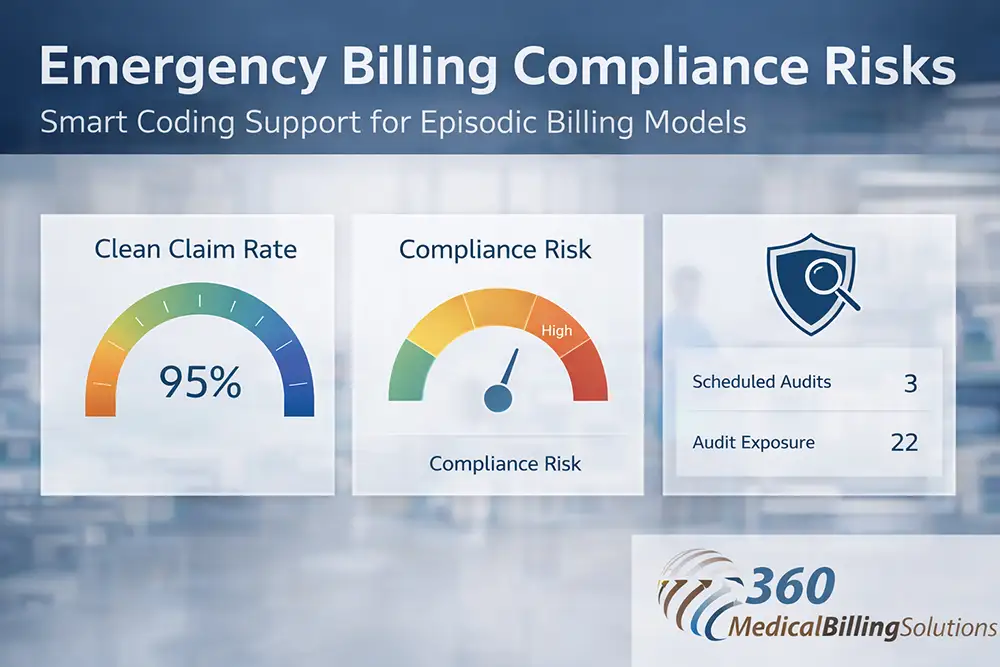
Emergency departments operate under an episodic care model—treating patients without prior relationships, often under incomplete information, and across a wide range of acuity levels. While this model is clinically necessary, it introduces unique emergency billing compliance risks that can expose facilities to denials, audits, and revenue loss if not managed carefully.
Smart coding support is essential to navigating these risks while maintaining compliance, accuracy, and financial stability.
Key Takeaways
- Episodic billing models carry elevated compliance risk
- Coding accuracy directly impacts emergency billing compliance
- Documentation gaps increase audit exposure
- Smart coding support helps prevent downstream billing issues
- Compliance must be proactive, not reactive
Why Episodic Billing Creates Compliance Risk
Unlike scheduled care, emergency billing relies on encounters that are:
- Unplanned and time-sensitive
- Documented under pressure
- Often completed after patient discharge
- Subject to payer scrutiny due to higher reimbursement variability
These conditions increase the likelihood of:
- Incomplete documentation
- Coding mismatches
- Medical necessity challenges
- Payer audits and recoupments
Without strong safeguards, episodic billing models can quickly become a compliance liability. These conditions significantly elevate emergency billing compliance risks, particularly when documentation and coding workflows are not tightly aligned.
Common Emergency Billing Compliance Pitfalls
Emergency departments frequently encounter compliance risks tied to coding and documentation workflows, including:
- Inconsistent E/M level assignment
- Insufficient medical decision-making documentation
- Missing or unclear chief complaints
- Diagnosis codes that don’t fully support the services billed
- Delayed or fragmented coding handoffs
These issues often go unnoticed until a denial or audit occurs—when the cost of correction is significantly higher.
The Role of Smart Coding Support
Smart coding support focuses on alignment, not shortcuts. It ensures that coding decisions are:
- Supported by documentation
- Consistent with payer guidelines
- Appropriate for the episodic nature of emergency care
This support helps reduce compliance risk by identifying potential issues early—before claims are submitted.
How Coding Support Strengthens Compliance
When coding support is integrated into emergency billing workflows:
- Documentation gaps are flagged early
- Coding inconsistencies are reduced
- Medical necessity is more clearly supported
- Audit exposure decreases
- Claims are more defensible if reviewed
The goal isn’t just to code faster—it’s to code correctly, consistently, and compliantly.
Compliance as a Revenue Protection Strategy
Compliance is often viewed as a regulatory burden, but managing emergency billing compliance risks through consistent emergency medical coding compliance is also a critical revenue protection strategy in emergency billing.
Facilities with strong compliance practices experience:
- Fewer denials tied to coding issues
- Less time spent on appeals
- Reduced audit risk
- More predictable reimbursement
In episodic billing models, compliance and revenue performance are directly connected.
Frequently Asked Questions (FAQs)
What makes emergency billing compliance different?
Episodic care, high acuity, and incomplete patient histories increase complexity.
Are coding errors a major compliance risk?
Yes. Coding inaccuracies are a leading cause of denials and audits.
Does your company provide coding services?
No. We work with our clients’ coding partners or recommend emergency-focused coding companies.
How does smart coding support help billing teams?
It improves alignment between documentation, coding, and billing before claims are submitted.
Can better coding reduce audit exposure?
Yes. Well-supported claims are more defensible during audits.
Are compliance risks higher in emergency departments than urgent care?
Generally, yes—due to acuity, variability, and reimbursement complexity.
How often should compliance workflows be reviewed?
Regularly—especially when payer rules or coding guidelines change.
Can compliance issues impact cash flow?
Absolutely. Delays, denials, and recoupments all affect revenue timing.
Does smart coding slow down billing?
No. When implemented correctly, it reduces rework and delays.
Is compliance only a concern during audits?
No. Compliance should be built into everyday billing operations.
How We Help Reduce Emergency Billing Compliance Risk
At 360 Medical Billing Solutions, we specialize exclusively in emergency room and urgent care billing. We understand the compliance challenges inherent in episodic billing models and work proactively to reduce risk before claims are submitted.
We collaborate closely with coding partners, monitor billing workflows, and apply compliance-focused billing strategies that help facilities avoid denials, audits, and unnecessary revenue disruption. Our goal is to support accurate, defensible billing while protecting long-term financial performance—often with little to no initial out-of-pocket cost for qualifying facilities.
Your Next Step
If compliance risk is creating uncertainty or slowing reimbursement, proactive oversight can make the difference.