Urgent care facilities run on speed. High visit volume, extended hours, and rapid patient turnover create unique billing pressures that don’t exist in scheduled care settings, resulting in persistent urgent care billing challenges. When claims aren’t clean the first time they’re submitted, the impact is immediate—delayed payments, increased rework, and cash flow instability.
This is where custom billing dashboards play a critical role. Visibility into claim status, urgent care denial trends, and workflow performance allows urgent care operators to spot issues early and protect revenue before small problems escalate.
Key Takeaways
- Clean claims are essential for maintaining urgent care cash flow
- Custom billing dashboards provide real-time visibility into claim performance
- Early detection of errors reduces denials and rework
- Dashboard-driven insights support proactive billing decisions
- Urgent care billing success depends on speed and accuracy
Why Clean Claims Are Critical in Urgent Care Billing
Urgent care centers operate with thin margins and rely on fast reimbursement cycles. Even minor claim errors can disrupt revenue flow when multiplied across hundreds or thousands of encounters each month.
Common threats to clean claims in urgent care billing include:
- Incomplete or inconsistent patient information
- Eligibility was not verified correctly at intake
- Payer-specific rules applied too late
- Workflow gaps between intake, coding, and billing
- Limited visibility into claim status after submission
Without clear insight into where claims are breaking down, billing teams are forced into reactive mode.
The Role of Custom Billing Dashboards in Claim Accuracy
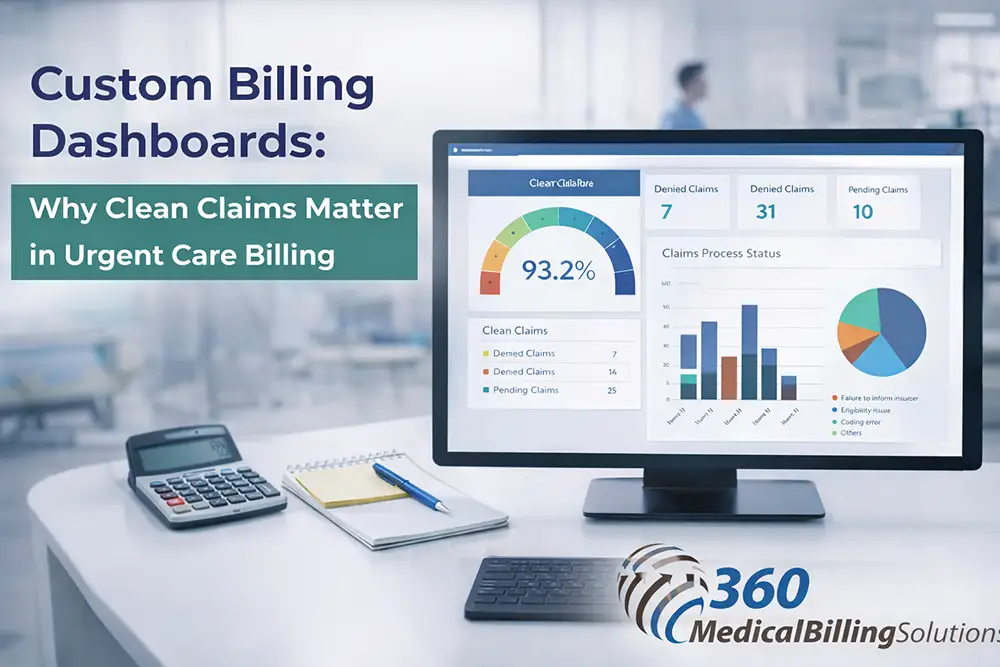
Custom billing dashboards centralize billing data and present it in a way that supports decision-making—not just reporting. Instead of waiting for end-of-month summaries, teams can see issues as they happen.
Effective dashboards help urgent care facilities:
- Track first-pass claim acceptance rates
- Monitor denial trends in near real time
- Identify payer-specific problem areas
- Flag recurring data or workflow errors
- Prioritize follow-up based on financial impact
This visibility is essential for maintaining clean claims in a fast-paced environment.
Connecting Dashboard Insights to Workflow Improvement
Dashboards are only valuable if the data is used to drive action. When billing performance metrics are reviewed regularly, patterns begin to emerge—often pointing directly to intake or workflow issues.
By analyzing dashboard data, urgent care operators can:
- Identify breakdowns in front-end registration
- Adjust eligibility verification processes
- Improve coordination with coding partners
- Strengthen submission and follow-up workflows
This connection between data and process improvement is what turns dashboards into a revenue-protection tool.
Clean Claims as a Denial Prevention Strategy
Denials are not random. In urgent care billing, they are usually tied to repeatable, preventable errors. Clean claims reduce the likelihood of denials by ensuring accuracy before submission.
When clean claim standards are enforced:
- Fewer claims enter denial workflows
- Appeals volume decreases
- Billing staff productivity improves
- Cash flow becomes more predictable
Dashboards make it easier to enforce these standards consistently across high-volume operations.
Using Dashboards to Support Scaling and Growth
As urgent care organizations expand—adding locations, providers, or services—billing complexity increases. Manual oversight quickly becomes unsustainable.
Custom dashboards support scalable growth by:
- Standardizing performance metrics
- Providing leadership-level visibility
- Highlighting location-specific issues
- Supporting consistent billing quality across sites
This level of insight is critical for organizations focused on growth without sacrificing revenue control.
Frequently Asked Questions (FAQs)
What are custom billing dashboards?
They are tailored reporting tools that provide real-time visibility into billing performance, claim status, and denial trends.
Why are dashboards important for urgent care billing?
High visit volume makes it difficult to identify issues without centralized, real-time data.
How do dashboards help improve clean claims?
They highlight errors and patterns early, allowing teams to fix issues before claims are denied.
Can dashboards reduce billing staff workload?
Yes. Better visibility reduces rework and unnecessary follow-up.
Are dashboards only useful for managers?
No. They support billing teams, leadership, and operations staff.
Do dashboards replace billing expertise?
No. They enhance expertise by providing actionable insights.
How often should dashboard data be reviewed?
Ideally weekly, and more frequently for high-volume facilities.
Can dashboards identify payer-specific issues?
Yes. They are especially useful for spotting payer-related trends.
Does your company provide coding services?
No. We work with our clients’ coding partners or can recommend urgent care–experienced coding companies.
Are dashboards customizable by facility?
Yes. Dashboards should be tailored to each organization’s workflow and goals.
How We Help Urgent Care Facilities Maintain Clean Claims
At 360 Medical Billing Solutions, we work exclusively with emergency rooms and urgent care facilities nationwide. We understand that clean claims are the foundation of reliable cash flow—especially in high-volume urgent care environments.
We use custom billing dashboards to give our clients clear visibility into claim performance, denial trends, and workflow gaps. By pairing data-driven insights with proactive billing strategies and close coordination with coding partners, we help urgent care organizations reduce rework, prevent denials, and stabilize revenue. For qualifying facilities, our services are available with little to no initial out-of-pocket costs.
Your Next Step
If claim delays or denials are impacting your urgent care cash flow, visibility is the first step toward fixing the problem.