Emergency departments depend on speed, accuracy, and seamless data exchange. When clinical and billing systems fail to communicate cleanly, the impact shows up quickly—claim delays, denials, rework, and frustrated staff. One of the most common contributors to these breakdowns is poorly implemented or misaligned HL7 interfaces.
Proper HL7 integration in medical billing is not just a technical concern. It is a revenue protection issue. When HL7 data flows correctly between clinical systems, registration, coding partners, and billing platforms, emergency department medical billing workflows become more efficient, compliant, and scalable
Key Takeaways
- HL7 integration in medical billing directly affects claim accuracy and reimbursement speed
- Poor data mapping creates workflow gaps that lead to denials and rework
- Emergency departments face unique HL7 challenges due to volume and episodic care
- Clean interfaces support downstream coding and billing accuracy
- Proactive monitoring prevents small data issues from becoming systemic revenue problems
Why HL7 Integration Matters in Emergency Department Billing
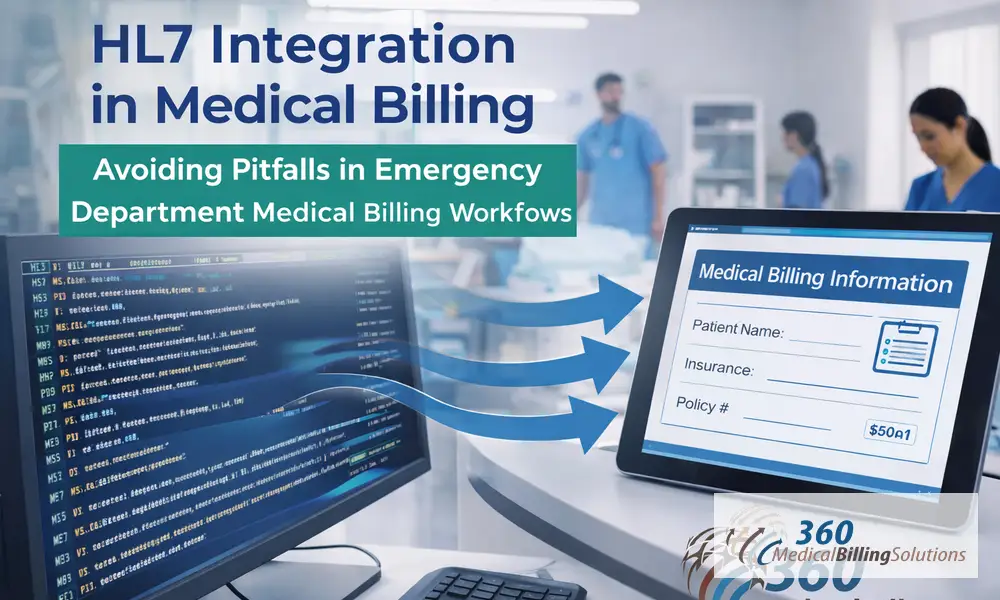
HL7 messaging is the backbone of data exchange between EHRs, registration systems, and billing platforms. In emergency departments, where encounters are fast and unpredictable, even small data mismatches can cascade into billing failures.
Common HL7-related issues include:
- Incomplete or delayed demographic feeds
- Missing insurance segments
- Encounter timing mismatches
- Inconsistent patient identifiers
- Breakdowns between clinical and billing status updates
When these issues occur, billing teams are forced to manually intervene—slowing reimbursement and increasing error rates.
How HL7 Failures Create Billing Workflow Pitfalls
Emergency department medical billing workflows rely on accurate, timely data. When HL7 feeds are misconfigured or poorly maintained, problems often appear downstream rather than at the point of failure.
Typical pitfalls include:
- Claims submitted with incomplete patient data
- Eligibility verified too late or with incorrect information
- Coding partners receiving inconsistent encounter details
- Billing systems operating on outdated or partial records
These gaps often surface as denials or delayed payments, even when documentation and coding are otherwise solid.
Aligning HL7 Integration in Medical Billing With Front-End Controls
Strong HL7 integration in medical billing works best when paired with front-end revenue controls such as eligibility verification and intake validation. HL7 feeds should reinforce—not undermine—these processes.
When alignment is in place:
- Patient demographics remain consistent across systems
- Insurance data flows correctly to billing platforms
- Encounter timing supports clean claim submission
- Coding partners receive reliable, structured data
This alignment reduces friction across emergency department medical billing workflows and supports cleaner first-pass claim acceptance.
The Role of Monitoring and Validation
HL7 interfaces are not “set it and forget it.” Emergency departments experience constant change—new payers, new workflows, system updates, and staffing shifts. Without ongoing monitoring, small interface issues can quietly erode revenue.
Effective HL7 oversight includes:
- Regular validation of message completeness
- Monitoring for dropped or delayed segments
- Cross-checking billing outcomes against interface performance
- Coordinating changes across IT, billing, and coding partners
Facilities that actively monitor HL7 performance avoid the slow revenue leaks that plague high-volume emergency settings.
Reducing Risk in Emergency Department Medical Billing Workflows
HL7-related issues often overlap with broader workflow gaps. By analyzing billing outcomes alongside interface performance, facilities can identify where technical issues intersect with process weaknesses, using denial trend analysis in revenue cycle to pinpoint recurring failure points tied to data integrity.
This approach helps:
- Reduce recurring denials tied to data integrity
- Improve billing staff efficiency
- Strengthen compliance and audit readiness
- Support scalable growth without added administrative burden
In emergency environments, where margins are tight, eliminating preventable workflow friction is critical.
Frequently Asked Questions (FAQs)
What is HL7 integration in medical billing?
It is the exchange of structured healthcare data between clinical systems and billing platforms using HL7 standards.
Why is HL7 especially important for emergency departments?
Emergency departments generate high-volume, episodic encounters that require fast, accurate data transfer.
How do HL7 issues impact billing outcomes?
They can lead to missing data, delayed claims, denials, and increased manual rework.
Are HL7 problems always obvious?
No. Many issues surface only after claims are delayed or denied.
Can HL7 issues affect eligibility verification?
Yes. Incomplete or delayed insurance data can undermine eligibility checks.
Does HL7 integration replace manual review?
No. It reduces errors but still requires oversight and validation.
How often should HL7 interfaces be reviewed?
At a minimum, quarterly, and whenever systems or workflows change.
Can HL7 problems create compliance risk?
Yes. Inaccurate data transmission can lead to documentation and submission issues.
Does your company manage HL7 interfaces directly?
We coordinate with client systems and partners to ensure billing-side data integrity, but we do not replace internal IT teams.
Is HL7 integration relevant for urgent care facilities?
Yes. High-volume urgent care centres face similar data flow and billing challenges.
Why Emergency and Urgent Care Facilities Trust Our Billing Team
At 360 Medical Billing Solutions, we specialize in medical billing for emergency rooms and urgent care facilities nationwide. We understand how data integrity, system integration, and workflow design directly affect revenue performance.
We work closely with our clients, their IT teams, and their coding partners to identify data flow gaps, strengthen emergency department medical billing workflows, and prevent avoidable revenue loss. Our focus is on denial prevention, operational clarity, and long-term stability—with little to no initial out-of-pocket costs for qualifying facilities.
Your Next Step
If data flow issues, delayed claims, or unexplained denials are affecting your emergency department billing performance, it’s time to take a closer look at your HL7 integration.