Emergency departments and urgent care facilities operate under constant pressure—high patient volume, limited intake time, and complex payer rules. In these environments, revenue integrity depends on getting critical decisions right at the very beginning of the billing process. One of the most impactful—and often underestimated—controls is real-time eligibility verification.
When eligibility is confirmed accurately at or near the time of service, it strengthens emergency medical coding best practices, reduces downstream denials, and stabilizes cash flow for organizations delivering emergency and urgent care services. When eligibility is missed or delayed, even well-documented encounters can unravel after submission.
Key Takeaways
- Real-time eligibility checks reduce preventable denials tied to inactive or incorrect coverage
- Accurate eligibility data supports emergency medical coding best practices by aligning payer rules early
- Front-end verification shortens reimbursement timelines and lowers rework volume
- Integrated eligibility workflows improve compliance and operational consistency
- Eligibility accuracy is a denial-prevention strategy—not a back-end fix
Why Eligibility Accuracy Is So Critical in Emergency and Urgent Care
Unlike scheduled care settings, emergency and urgent care facilities often have incomplete or rushed registration data. Patients may be unable to provide full insurance details, and staff must prioritize care over intake.
This reality creates common risks such as:
- Coverage is inactive on the date of service
- Incorrect payer selection or sequencing
- Missing secondary insurance
- Demographic mismatches that trigger payer rejections
- Unverified plan exclusions
These breakdowns frequently surface later as denial patterns tied to preventable intake and verification issues.
How Real-Time Eligibility Checks Protect the Revenue Cycle
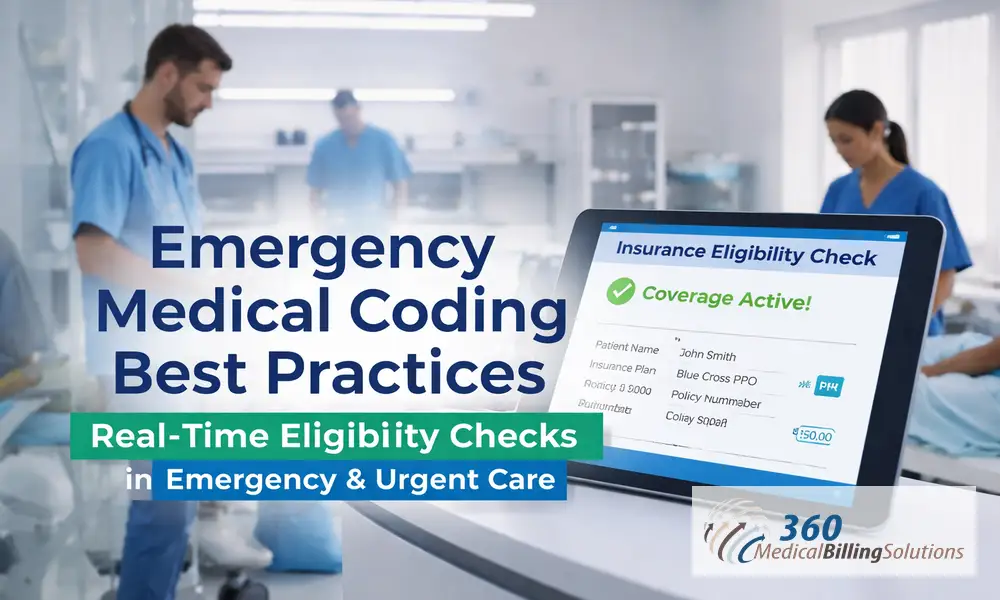
Real-time eligibility verification queries payer systems—typically routed through a medical billing clearinghouse—to confirm coverage status before claims are finalized. This allows billing teams to identify problems early, while corrective action is still possible.
With real-time eligibility checks, facilities can:
- Validate active coverage immediately
- Identify payer-specific billing rules
- Reduce manual follow-up and rework
- Prevent avoidable claim denials
This proactive approach reinforces clean claim workflows and reduces compliance exposure.
Strengthening Emergency Medical Coding Best Practices at the Front End
Eligibility verification and coding accuracy are tightly connected. Coders rely on correct payer information to apply the appropriate rules, modifiers, and documentation standards. When eligibility data is wrong or incomplete, claims can fail regardless of coding quality.
By confirming coverage early, facilities strengthen emergency medical coding best practices by:
- Aligning coding decisions with verified payer requirements
- Reducing wrong-payer and sequencing denials
- Minimising claim edits and resubmissions
- Supporting cleaner first-pass acceptance
This alignment closes workflow gaps that commonly lead to revenue leakage in episodic care environments.
The Role of Integration and Automation
Eligibility checks are most effective when integrated into the broader billing infrastructure. Clearinghouse connectivity combined with HL7 integration in medical billing ensures patient demographics and encounter data move accurately between clinical and billing systems.
When eligibility workflows are automated and integrated:
- Data mismatches are reduced
- Claims are prepared faster after encounters
- Reporting accuracy improves
- High-volume environments remain scalable
These efficiencies are especially important for facilities facing persistent urgent care billing challenges tied to speed and volume.
Eligibility as a Denial Prevention Strategy
Denial prevention starts before claims are submitted. Eligibility-related denials are among the most preventable when rapid daily verification is standard practice as part of effective denial prevention strategies.
Effective eligibility controls help facilities:
- Reduce wrong-payer denials
- Avoid inactive coverage rejections
- Shorten days in accounts receivable
- Decrease appeal and rework volume
Over time, these improvements translate into stronger cash flow and lower operational friction.
Operational and Financial Impact
Beyond compliance, daily eligibility checks deliver measurable operational benefits. Billing teams spend less time correcting errors and more time managing performance and optimization within a structured billing platform designed for emergency and urgent care workflows.
Facilities typically see:
- Faster reimbursement cycles
- Improved revenue predictability
- Lower administrative overhead
- Better visibility into intake and payer trends
For emergency and urgent care providers, these gains directly support long-term financial stability.
Frequently Asked Questions (FAQs)
What are real-time eligibility checks in medical billing?
They are instant queries that confirm a patient’s insurance coverage and benefits at or near the time of service.
Why are eligibility errors common in emergency care?
Emergency settings prioritize treatment over registration, increasing the risk of incomplete or inaccurate insurance data.
How do eligibility checks support emergency medical coding best practices?
They ensure coders apply the correct payer rules and submission logic from the start.
Can accurate coding still result in a denial if eligibility is wrong?
Yes. Incorrect or inactive coverage can cause denials regardless of coding accuracy.
How fast are real-time eligibility responses?
Most responses are returned within seconds through clearinghouse systems.
Do eligibility checks slow down patient intake?
When integrated properly, they operate in the background without disrupting workflows.
Is eligibility verification important for urgent care facilities?
Absolutely. High visit volume makes eligibility accuracy critical for cash flow.
Can eligibility data be used for reporting and improvement?
Yes. Patterns in eligibility errors can highlight intake and workflow gaps.
Does 360 Medical Billing Solutions provide coding services?
No. 360 Medical Billing Solutions works with the client’s coding partner or can recommend an emergency-focused coding company.
Is eligibility verification a replacement for coding review?
No. It complements coding by ensuring claims start with accurate payer information.
How 360 Medical Billing Solutions Helps
360 Medical Billing Solutions specializes in medical billing services for emergency rooms and urgent care facilities nationwide. With 25 years of industry experience, our company focuses on denial prevention, compliance, and revenue optimization—working alongside each client’s coding partner to support clean, accurate claims.
This approach emphasizes transparency, advanced reporting, and operational efficiency, with little to no initial out-of-pocket costs for qualifying facilities.
Your Next Step
If eligibility errors or delayed payments are affecting your revenue cycle, a proactive strategy can make a measurable difference.