Introduction: Why Compliance Failures Hurt Emergency Departments First
Emergency departments operate under intense pressure—high patient volumes, rapid clinical decision-making, and constantly evolving payer and regulatory requirements. In this environment, compliance gaps often go unnoticed until they surface as denied claims, delayed reimbursements, or payer audits.
Unlike other care settings, emergency services face heightened scrutiny due to EMTALA requirements, No Surprises Act provisions, and complex documentation standards tied to episodic care. When compliance issues arise in emergency medical billing, the financial impact is immediate and costly. This is why emergency medical billing compliance audits are no longer optional—they are a critical safeguard for revenue stability.
Key Takeaways
In this article, you’ll learn:
- What emergency medical billing compliance audits actually evaluate
- How compliance audits differ from coding audits
- Common compliance risks unique to emergency departments
- How proactive auditing prevents denials, recoupments, and penalties
- What an effective compliance audit process should include
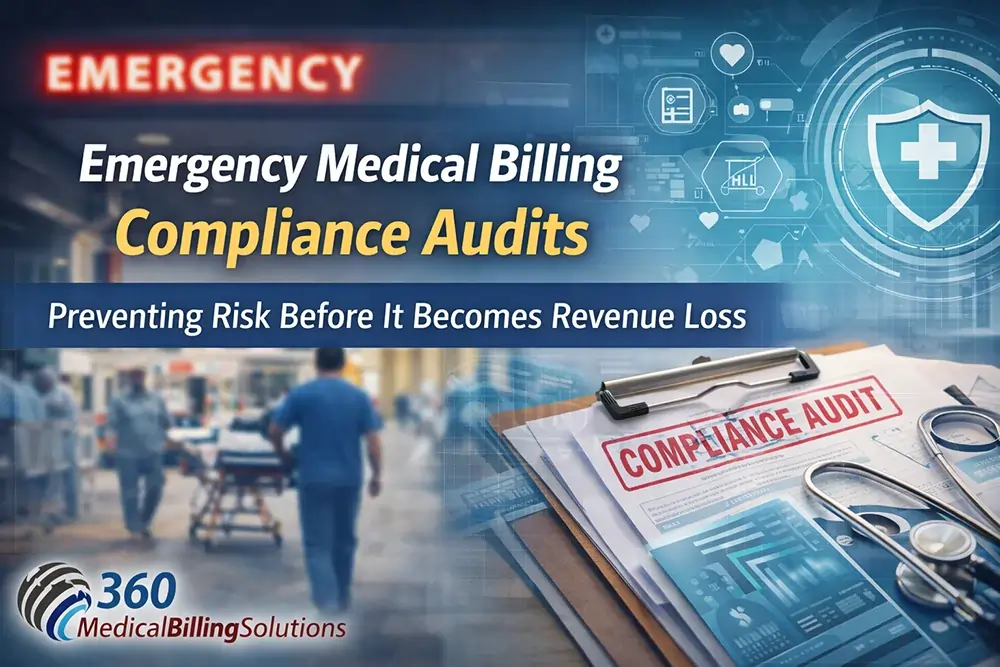
What Are Emergency Medical Billing Compliance Audits?
Emergency medical billing compliance audits are structured reviews of billing workflows, documentation processes, payer rules, and regulatory alignment. Their goal is not to recode claims, but to identify systemic risks that could trigger denials, audits, or repayment demands.
These audits focus on:
- Documentation completeness and consistency
- Alignment with federal and state regulations
- Payer-specific billing requirements
- Workflow breakdowns that cause billing delays or errors
Importantly, compliance audits are not coding audits. Coding accuracy is reviewed by trusted third-party coding partners, while compliance audits evaluate whether billing operations support accurate, defensible claims submission.
Why Emergency Departments Face Higher Compliance Risk
Emergency departments are uniquely vulnerable due to:
- Unscheduled patient encounters
- High reliance on E/M levels and critical care billing
- Time-sensitive documentation
- Frequent payer disputes over medical necessity
Even small documentation gaps can escalate into widespread denial trends. Emergency department medical billing demands constant oversight to ensure compliance keeps pace with clinical reality.
Common Compliance Red Flags in Emergency Room Billing
Facilities often discover compliance issues only after revenue is affected. Common warning signs include:
- Increasing denial rates are tied to documentation
- Payer requests for records and post-payment reviews
- Inconsistent charge capture across shifts or providers
- Delays between patient encounter and claim submission
Emergency room billing compliance issues compound quickly when left unaddressed, especially in high-volume environments.
How Compliance Audits Prevent Revenue Loss
Proactive emergency medical billing compliance audits identify risk before claims are submitted—or before payers take action. By reviewing workflows and billing patterns, facilities can:
- Reduce avoidable denials
- Improve first-pass claim acceptance
- Strengthen audit defense readiness
- Maintain regulatory alignment
For example, identifying documentation bottlenecks early allows facilities to correct processes without disrupting provider workflows.
The Role of Technology and Data Oversight
Modern compliance audits rely on integrated billing platforms that connect clearinghouse data, payer responses, and reporting tools. This visibility allows billing teams to detect trends such as recurring denial reasons or delayed submissions.
While coding expertise is provided through specialized third-party partners, compliance audits ensure that the overall billing ecosystem supports accurate and timely reimbursement.
Why Reactive Audits Cost More
Facilities that wait for payer audits or revenue shortfalls often face:
- Retroactive claim corrections
- Repayment demands
- Administrative burden and staff burnout
Emergency departments benefit most when compliance audits are embedded into routine billing oversight—not treated as a crisis response.
FAQs: Emergency Medical Billing Compliance Audits
What is the purpose of emergency medical billing compliance audits?
They identify operational and regulatory risks that could lead to denials, penalties, or delayed reimbursement.
Are compliance audits the same as coding audits?
No. Coding audits are performed by specialized third-party coding partners, while compliance audits evaluate billing workflows and regulatory alignment.
How often should emergency departments conduct compliance audits?
Ongoing or scheduled audits are recommended to keep pace with payer and regulatory changes.
Do compliance audits slow down billing operations?
When done correctly, they improve efficiency by reducing rework and denials.
What regulations affect emergency billing compliance most?
EMTALA, the No Surprises Act, payer-specific policies, and state regulations.
Can compliance audits reduce payer audits?
Yes. Strong internal compliance reduces payer scrutiny and audit risk.
Who should perform compliance audits?
Experienced billing professionals using integrated billing systems and data analysis.
Do audits require changing providers’ documentation habits?
The goal is process improvement, not provider disruption.
How do compliance audits support cash flow?
By increasing clean claim rates and minimizing payment delays.
Are compliance audits suitable for all emergency departments?
Yes, regardless of size or volume.
How 360 Medical Billing Solutions Supports Compliance
360 Medical Billing Solutions conducts compliance-focused audits that evaluate emergency billing workflows, documentation integrity, and payer alignment—while collaborating with trusted third-party coding partners for coding accuracy.
With 25 years of experience supporting emergency and urgent care facilities nationwide, 360 helps providers stay compliant without adding administrative burden. Services are delivered without hidden costs and with little to no out-of-pocket initial costs.
Take the Next Step
Emergency billing compliance issues don’t announce themselves—they surface as lost revenue. A proactive audit strategy protects both reimbursement and reputation.