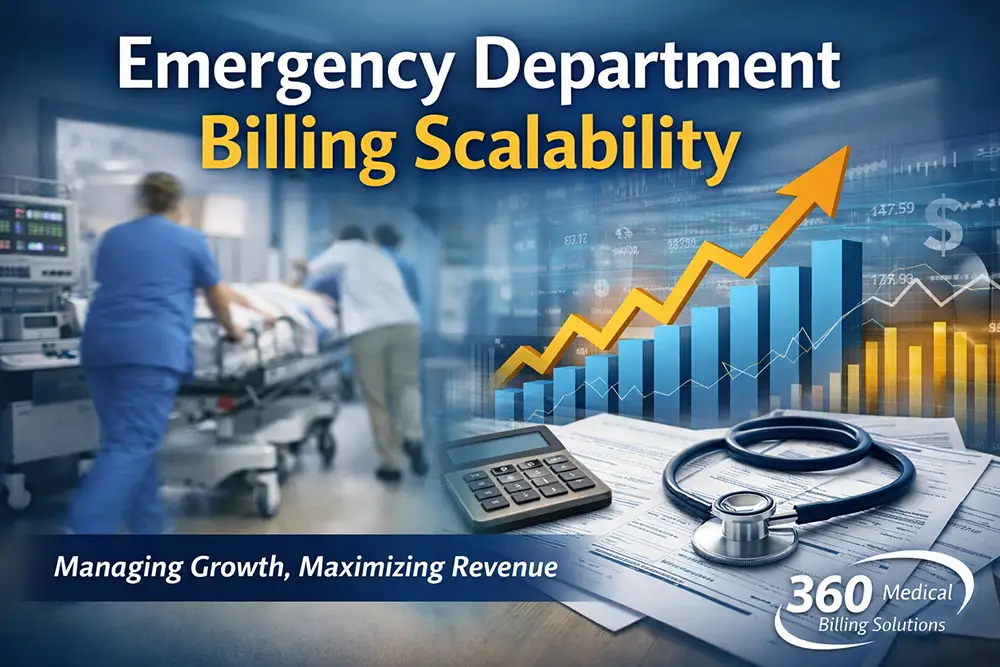
emergency department billing scalability is no longer a back-office function—it is a strategic imperative for hospitals experiencing rising ER volume, expanding service lines, or seasonal patient surges. When patient throughput increases but billing infrastructure remains static, denials climb, AR days expand, and reimbursement delays follow. Hospitals that prioritize emergency department billing scalability protect cash flow while maintaining operational stability.
As payer scrutiny intensifies and staffing pressures continue, scalable revenue cycle systems determine whether growth translates into financial strength—or revenue disruption.
Key Takeaways
- Emergency department billing scalability is essential when ER volume increases.
- Front-end registration accuracy must scale with patient throughput.
- Denial management systems must adapt to payer rule changes in real time.
- Integrated billing platforms and HL7 connectivity improve clean claim rates.
- Structured scalability strategies protect cash flow without hidden costs.
Why Emergency Department Billing Scalability Matters
Emergency departments face unpredictable volume spikes, including seasonal illness trends, regional population growth, and expanded hospital services. Without structured emergency department billing scalability, even well-performing revenue cycle teams become overwhelmed.
Scalability involves more than staffing adjustments. It requires:
- Automated claim scrubbing
- Payer-specific denial tracking
- Real-time reporting dashboards
- Clearinghouse synchronization
- Seamless HL7 integration
Hospitals that lack scalable systems often experience increased write-offs precisely when patient demand rises.
Front-End Processes Must Scale First
Many revenue breakdowns originate at registration. As patient intake accelerates, error rates increase unless systems are structured for growth.
Common scalability gaps include:
- Insurance verification bottlenecks
- Demographic entry errors
- Incomplete authorization capture
Emergency department billing scalability begins at the front end. When intake accuracy improves, downstream denial rates decline significantly.
Denial Management in High-Volume Environments
Payers are increasing review of high-acuity emergency claims, imaging utilization, and medical necessity documentation. During volume growth, denial follow-up often becomes inconsistent.
A scalable denial strategy includes:
- Automated root-cause analysis
- Standardized appeal workflows
- Payer trend reporting
- KPI monitoring across service lines
Hospitals that implement disciplined denial tracking see improved net collections even during volume expansion.
Technology Infrastructure and Integration
True emergency department billing scalability depends on integrated technology. Fragmented systems introduce manual intervention points that slow reimbursement.
360 Medical Billing Solutions uses a dedicated billing platform integrated with internal systems and clearinghouse data. HL7 connectivity ensures real-time demographic and charge flow, reducing front-end errors and improving clean claim performance.
Without this level of integration, scalability becomes reactive rather than strategic.
Coding Coordination and Compliance Oversight
Emergency departments require coordination between billing operations and coding partners.
360 does not provide coding services. Instead, we collaborate directly with your trusted third-party coding partner—or recommend an emergency-focused coding company—to ensure documentation alignment, E/M accuracy, and payer compliance consistency.
Scalable systems must support both billing operations and coding accuracy to reduce compliance exposure.
Financial Impact of Poor Scalability
When emergency department billing scalability is neglected, hospitals experience:
- Increased AR days
- Higher denial write-offs
- Revenue volatility
- Compliance audit risk
Emergency departments that implement structured scalability strategies stabilize reimbursement even as patient volume grows. 360 MBS operates with no hidden costs and little to no initial out-of-pocket costs, allowing facilities to improve revenue performance without large capital investment.
Frequently Asked Questions (FAQs)
What is emergency department billing scalability?
It is the ability of a hospital’s billing infrastructure to handle increased ER volume without rising denials or delayed reimbursement.
Why does volume growth increase denials?
Higher patient throughput often increases registration errors and documentation inconsistencies.
How does HL7 integration support scalability?
HL7 ensures accurate data exchange between systems, reducing manual errors.
Can denial rates improve during volume growth?
Yes, if structured denial tracking and reporting systems are implemented.
Does scalability require new billing software?
Effective scalability typically requires an integrated billing platform with reporting transparency.
How do coding partners impact scalability?
Accurate coding alignment prevents payer audits and reimbursement delays.
What KPIs should hospitals monitor?
Net collection rate, clean claim rate, AR days, denial rate, and payer turnaround times.
How long does scalability implementation take?
Transition timelines typically range from 30–90 days depending on system integration complexity.
Are there hidden costs in scalable billing models?
Strategic partners operate with transparent agreements and no hidden costs.
Can hospitals maintain their existing coding relationships?
Yes. 360 works with your current coding partner or recommends emergency-focused specialists.
About 360 Medical Billing Solutions
360 Medical Billing Solutions specializes in emergency and urgent care revenue cycle management nationwide. With 25 years of experience, we support facilities across Oklahoma, Florida, Texas, Arizona, Colorado, Michigan, and Georgia.
- No hidden costs
- Little to no out-of-pocket initial costs
- Dedicated billing platform integrated with internal systems
- Coordination with trusted third-party coding partners
Take the Next Step
If you are evaluating the outsourcing medical billing pros and cons for your emergency department or urgent care facility, request a strategic consultation to assess your current performance metrics and revenue opportunity gaps.